Art, cypresses and beautiful sunsets
Right after the Colosseum in Rome, few sights are as iconic for Italy as the rolling hills of Tuscany.
Cypress trees dot the landscape, accompanied by numerous incredible cities rich in Italian culture, historic churches and charming streets.
Most people know about Florence and the Leaning Tower of Pisa. Perhaps even Lucca and Siena.
But have you heard about San Gimignano, Montepulciano, Pienza, Radicofani and Bagni San Filippo?
Tuscany offers a wealth of experiences beyond its historic, tower-filled cities. It features natural thermal baths and some of the best food and drink the boot-shaped country has to offer.
We love Italy and have spent a lot of time in the country, particularly in the Dolomites and in Sardinia.
During our journey from the Italian mountains to the Sardinian heat in the fall of 2022, we decided to do a Tuscany road trip along the way to explore some of the best things to do.
We certainly don’t regret it!
In this travel guide to Tuscany, we cover the best cities to visit, as well as other things to do and sights you can’t miss on your road trip. We also cover where to stay in Tuscany, when to visit and share our best tips throughout the guide.
Table of contents
- Map of Tuscany
- Florence – The jewel of Tuscany
- Siena – Tuscany’s second most beautiful city
- Pisa – See the world-famous Leaning Tower
- Lucca – Medieval city with historic city wall
- San Gimignano – The Town of Fine Towers
- Livorno – Tuscany’s vibrant port city
- Pienza – Tuscany’s most romantic Renaissance town
- Montalcino – Wine-producing medieval town
- Montepulciano – Cosy hilltop town
- Radicofani – A quaint stop off the beaten path
- Saturnia – Italy’s most famous thermal baths
- Bagni San Filippo – Thermal baths in the middle of the forest
- Winding Road – Famous Tuscan sunset spot
- Bonus: Cinque Terre – Five colourful coastal towns
- Where to stay in Tuscany?
- When to visit Tuscany?
Map of Tuscany
Here is a map of Tuscany – a region located in the northern part of central Italy next to the Mediterranean Sea.
Tuscany borders Liguria (with Genoa) and Emilia-Romagna (with Bologna) to the north, Umbria (with Perugia) in the east and Lazio (with Rome) in the south.
The Apuan Alps dominate the landscape in the northern part of Tuscany, while the rest of the region is more hilly than mountainous.
The map below provides an overview of all the cities and sights mentioned in this guide.
Florence – The jewel of Tuscany
Perhaps Italy’s most beautiful city, Florence, is a must-see on any trip to Tuscany.
Home to the magnificent cathedral, Michelangelo’s David and the historic Ponte Vecchio bridge. Florence has some of the world’s most iconic landmarks.
Spend your days admiring stunning churches, exquisite architecture and looots of historic art galleries.
We stayed four days in Florence wandering the picturesque streets, eating delicious food and visiting as many attractions as possible.
The highlights include sunsets at stunning viewpoints, breathtaking artwork and, of course, yummy gelato.
We look forward to returning to one of the best cities in Tuscany for more one day!
Discover more about the capital of Tuscany in our comprehensive travel guide to Florence.
Search for the cheapest and best hotels in Florence here (adlink).


Everything you need to know about Florence in Tuscany, including what to do & our top tips
Read more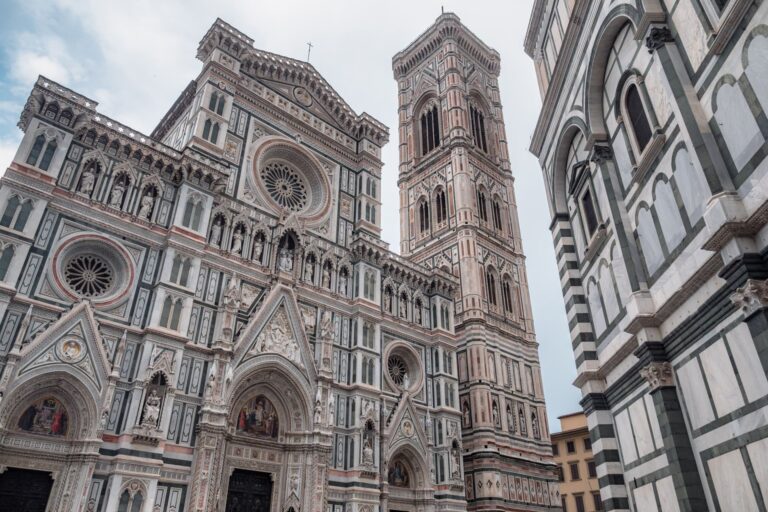
Our personal accommodation recommendations from budget to luxury stays in Florence
Read moreSiena – Tuscany’s second most beautiful city
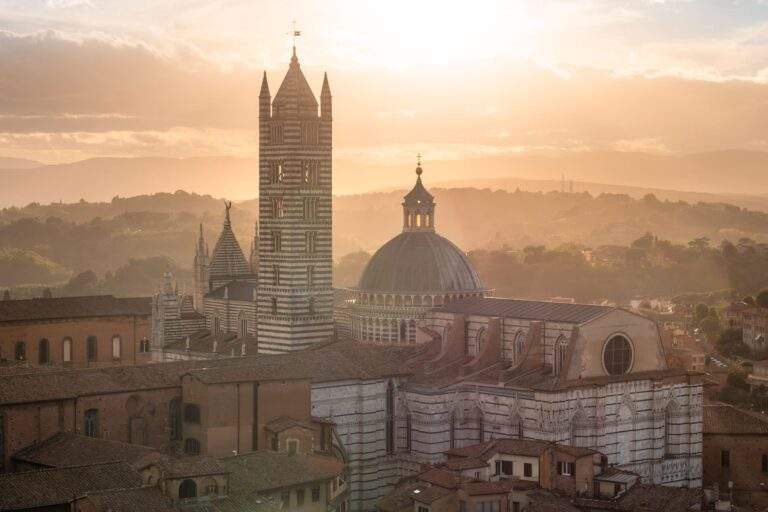
Another must-visit city in Tuscany is Siena.
From the moment we set foot in Siena, we were in love.
Perched high above the hilly countryside, Siena’s ancient buildings tower over Tuscany with a unique grandeur and splendour.
While Florence is hard to surpass, Siena makes a commendable effort.
The Cathedral (like its counterpart in Florence) is exceptional and it’s easily one of the most beautiful churches we’ve ever seen.
For the complete experience, we purchased an “Opa Si Pass” (adlink), providing access not only to the cathedral but also to the crypt, the cathedral museum and the Panorama dal Facciatone, offering a truly spectacular view of the city and the church. The walk across the roof (Porta del Cielo) needs a separate ticket.
Apart from the cathedral, a visit to the shell-shaped Piazza del Campo is essential. Here, you can ascend the city hall tower, Torre del Mangia, where the 360-degree vista of Siena and the surrounding countryside is unrivalled.
Read much more about the best things to do in the stunning city in our detailed travel guide to Siena.
Search for the cheapest and best hotels in Siena here (adlink).


Everything you need to know about Siena in Tuscany, including what to see and our top tips
Read more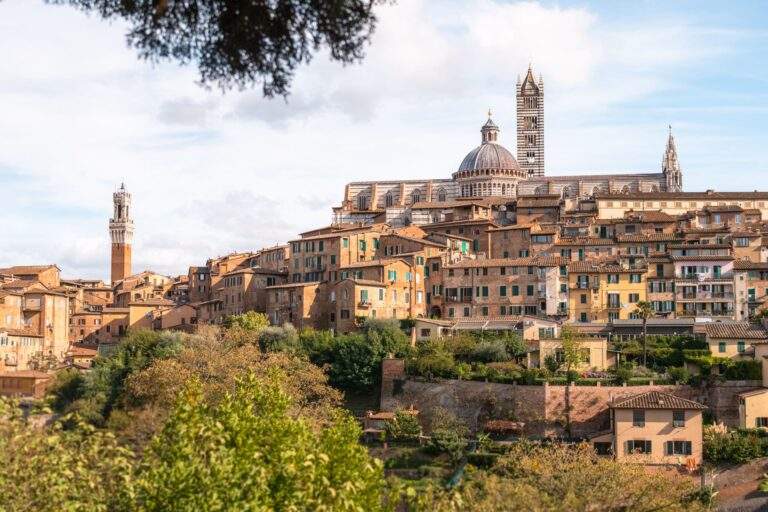
Our recommendations for the best places to stay in Siena, Tuscany
Read moreAdvertisement
Pisa – See the world-famous Leaning Tower
Let’s face it… It is a bit touristy to pose and pretend to “push” the Leaning Tower of Pisa for a silly picture. However, we must admit it’s an experience worth indulging in when you’re in Tuscany.
Pisa is more than just its iconic tower and the many photo opportunities; it’s a vibrant city with pretty streets, impressive buildings and beautiful churches.
As Pisa is a university city, lots of young people live there. The atmosphere is lively and there are plenty of dining options.
Apart from seeing the tower, we truly enjoyed the rest of Piazza dei Miracoli (The Square of Miracles) and walking along the Arno River.
The Leaning Tower of Pisa is one of the best things to do in Tuscany, and you can check out what else you can do and see nearby in our travel guide to Pisa.
Search for the cheapest and best hotels in Pisa here (adlink).


Everything you need to know about Pisa in Tuscany, including what to do & our top tips
Read more
Our recommendations for the best hotels in Pisa, Italy
Read more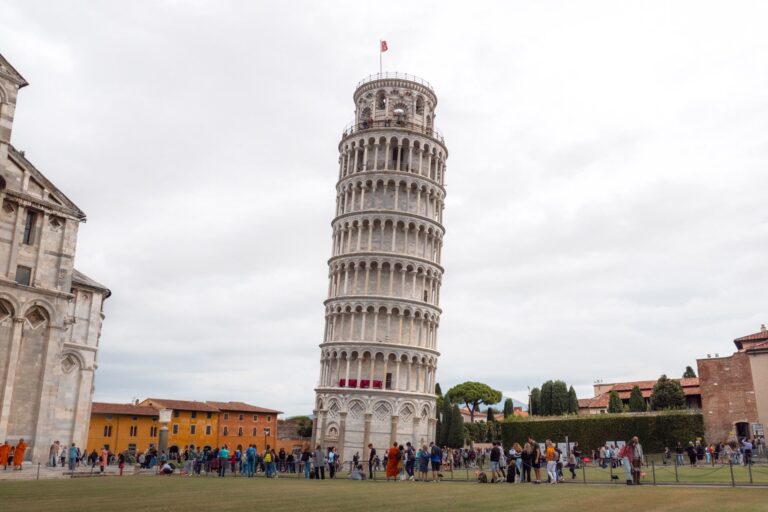
Everything you need to know about the Leaning Tower of Pisa, including why it leans and the best way to visit
Read moreAdvertisement
Lucca – Medieval city with historic city wall
Lucca is increasingly catching the eye of tourists – and for very good reason.
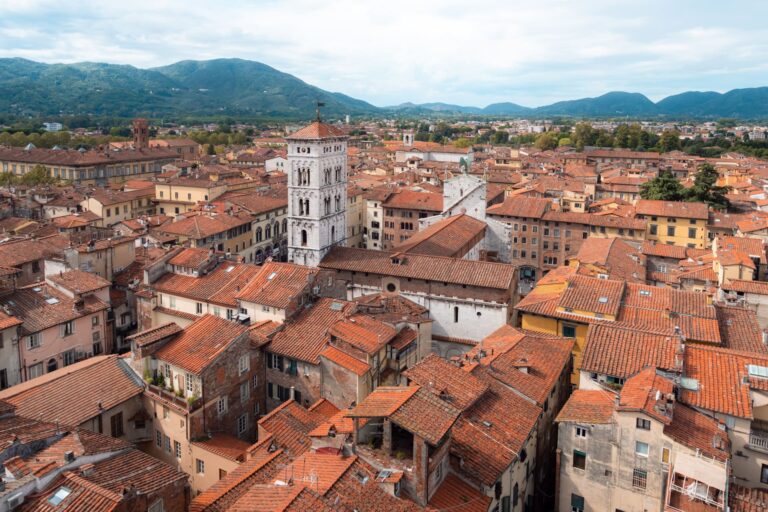
The old town is encircled by a ~4-kilometre-long wall, which you can walk around in its entirety.
Behind the wall lies one of Tuscany’s most charming towns.
Although the old town isn’t large, it offers experiences and photogenic buildings at every street corner.
Highlights include the Piazza dell’Anfiteatro, the Guinigi Tower, the Bell Tower and, of course, the city’s cathedral.
On our Tuscany road trip, we stayed five nights in Lucca.
It’s not necessary to stay that long to experience the city (it can be done in a day or two), but Lucca is also an excellent starting point for trips to Pisa, Livorno, Florence, Cinque Terre and other places nearby.
Read much more about what to do and see in the medieval city in our comprehensive travel guide to Lucca.
Search for the cheapest and best hotels in Lucca here (adlink).


Everything you need to know about Lucca in Tuscany, including what to do & our top tips
Read more
Our recommendations for the best places to stay in Lucca, Italy
Read moreSan Gimignano – The Town of Fine Towers
San Gimignano is a lovely town built on a high hill with great views of the surrounding landscape.
Due to the abundance of towers in the 13th century, it has gained the nickname the “Manhattan of the Middle Ages”.
These medieval towers were constructed by San Gimignano’s patriarchal families to showcase their wealth.
Today, only 14 towers remain, down from the original 72, some of which reached heights of up to 70 metres. A remarkable feat for the 13th century!
We highly recommend ascending Torre Grossa, which offers stunning views as well as taking a walk to a park with an old fortress.
See lots of pictures and read more about the Town of Fine Towers in our travel guide to San Gimignano.
Search for the cheapest and best hotels in San Gimignano here (adlink).
Accommodation tip: The wonderful Agrivilla I Pini (adlink) is situated on the outskirts of San Gimignano. It offers a perfect blend of rustic charm and luxury, complete with a pool and surrounded by tranquil nature. Check out our detailed review of the unique hotel.


Everything you need to know about San Gimignano in Tuscany, including what to do & our top tips
Read more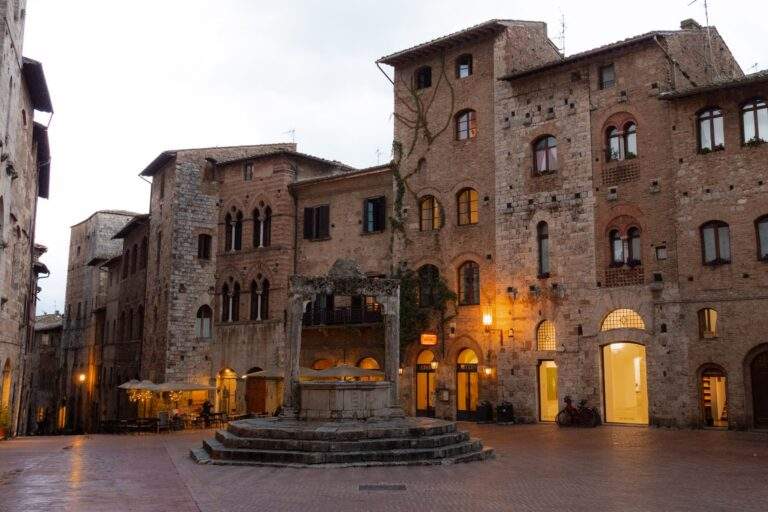
Our recommendations for the best places to stay in San Gimignano, Tuscany
Read more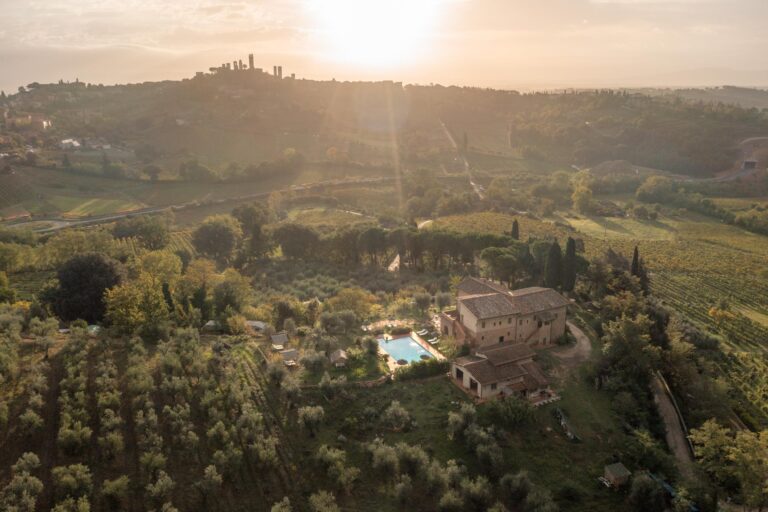
We review our stay at Vegan Agrivilla I Pini, Tuscany, Italy
Read moreAdvertisement
Livorno – Tuscany’s vibrant port city
We’ve visited Livorno four times now to catch the ferry to and from Olbia in Sardinia from mainland Italy.
On these occasions, we either stopped briefly to buy provisions for the journey or spent a few hours exploring before departure.
While Livorno hasn’t quite surprised us with the same charm and beauty as Florence, Siena and Lucca, it remains one of Tuscany’s largest and most significant cities.
There’s plenty to do to justify a visit and Livorno’s many canals add to its cosy atmosphere.
As with any Italian city, strolling through the historic city centre is highly recommended.
If you have the time, don’t miss the checkerboard terrace (Terrazza Mascagni).


Pienza – Tuscany’s most romantic Renaissance town
With only around 2,000 inhabitants, Pienza is small. However, it’s probably the most charming mini-town in Tuscany.
A must-see is the central square Piazza Pio II with the Pope’s palace, the bishop’s palace and the stunning cathedral.
We wanted to explore every narrow street in the centre and were provided with countless photo opportunities.
With its high location in the countryside, Pienza has many scenic viewpoints over the UNESCO-listed natural area of Val d’Orcia.
Furthermore, Pienza itself is designated as a UNESCO World Heritage Site as the historic centre is the earliest example of an “ideal Renaissance town”.


Montalcino – Wine-producing medieval town
West of Pienza and Montepulciano lies the small town of Montalcino, which is best known as the birthplace of Brunello di Montalcino wine.
Although we’re not avid wine enthusiasts ourselves, we liked exploring the medieval town situated at over 500 metres above sea level.
For those planning to explore the numerous wine bars (and there are plenty!), staying overnight in the town would likely be a wise choice. However, a day trip lasting a few hours can also be quite fulfilling.
The surrounding area is dotted with vineyards.


Advertisement
Montepulciano – Cosy hilltop town
Montepulciano lies to the east of the aforementioned Pienza and Montalcino and this is another Tuscan gem.
The town is beautifully positioned on top of a hill – a recurring theme in Tuscany.
Here, you can leisurely spend a few hours (or more) wandering its cosy streets and look at the well-preserved Renaissance architecture, which we did with great delight.
Aside from being a major tourist destination, Montepulciano is known for its wine “Vino Nobile di Montepulciano” and there are of course vineyard tours and tastings available.


Radicofani – A quaint stop off the beaten path
The small town of Radicofani wasn’t originally on our Tuscany itinerary but we found a charming apartment on Airbnb at a great price, so we decided to spend one night there.
Radicofani is indeed tiny and requires a short detour off the main road. However, we believe it’s well worth the visit.
The drive is scenic and wandering the untouristy streets feels like stepping back in time among beautiful old buildings (and elderly locals). It’s a pleasant break from the many crowds you’ll undoubtedly meet in the bigger Tuscan cities.
Tip: Consider visiting the town’s fort, Fortezza di Radicofani, located high on a cliff for great views.


Saturnia – Italy’s most famous thermal baths
The thermal baths at Saturnia, also known as Cascate del Mulino, are one of Italy’s most beautiful natural attractions.
When we saw photos of the baths online, we knew we had to visit one day. The light blue colour of the water is absolutely stunning!
The heat sources are completely natural and the thermal activity keeps the water at a soothing 37.5°C year-round (99.5°F). In other words, it’s a perfect outdoor spa.
These hot springs are quite popular, so we arrived very early in the morning to enjoy the hot water in the cool morning air without too many other people.
While the area is free to visit, the nearby parking (only a few minutes’ walk away) requires a fee.
Read about the Instagram-famous hot springs, facilities, what to expect and more in our Saturnia Hot Springs guide.


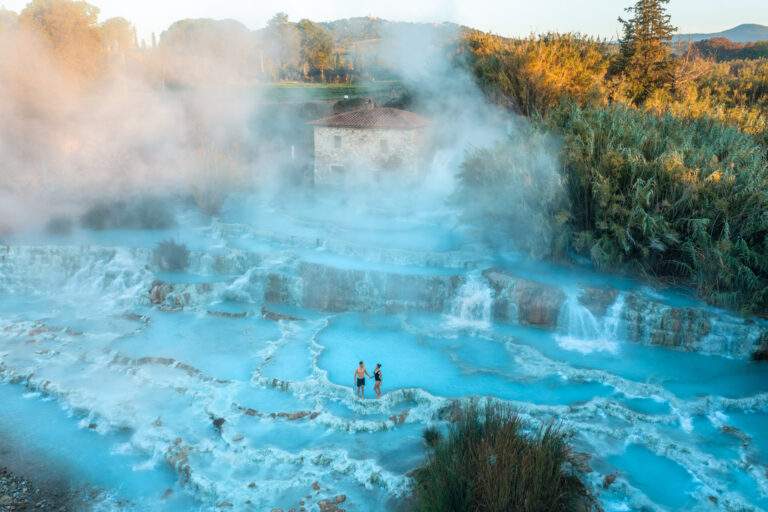
What to expect at Cascate del Mulino’s famous natural pools, including how to get there and our best tips
Read moreBagni San Filippo – Thermal baths in the middle of the forest
Bagni San Filippo hasn’t yet reached the popularity of the hot springs at Saturnia.
They’re not quite as accessible but the thermal baths in the forest are also beautiful and perfectly warm.
Paid parking is available along the road and from there, it’s a few minutes’ walk to the start of the spring.
You’ll need to follow the (occasionally muddy) path along the water until you find a suitable pool to relax in.
We only encountered a handful of people in the morning and we loved the tranquillity.
Check out how to visit the hidden hot springs in our Bagni San Filippo guide.


How to visit, what to expect and our best tips for the natural hot springs in southern Tuscany
Read moreWinding Road – Famous Tuscan sunset spot
If you’ve seen pictures of Tuscany’s iconic rolling hills and cypress trees, chances are that you have seen this particular spot of a winding road at sunset in the Crete Senesi, just north of Val d’Orcia.
This area happens to be the entrance to the hotel Agriturismo Baccoleno (adlink), located approximately 6 kilometres from the town of Asciano (midway between Siena and Pienza).
Fortunately, the hotel allows visitors to climb the hill for breathtaking sunset views.
We arrived just before sunset on a day in late September and we were surprised by the number of photographers ready to capture the perfect shot. So, expect some company…
However, you can bring a blanket and a packed lunch for a romantic picnic at sunset.
Read about how to get there, where to park and our best tips in our guide to the best sunset spot in Tuscany.
Restaurant recommendation: Just a 13-minute drive from the sunset spot, we enjoyed a wonderful, completely vegan Italian dinner at Pizzeria Paradiso in the town of Trequanda.


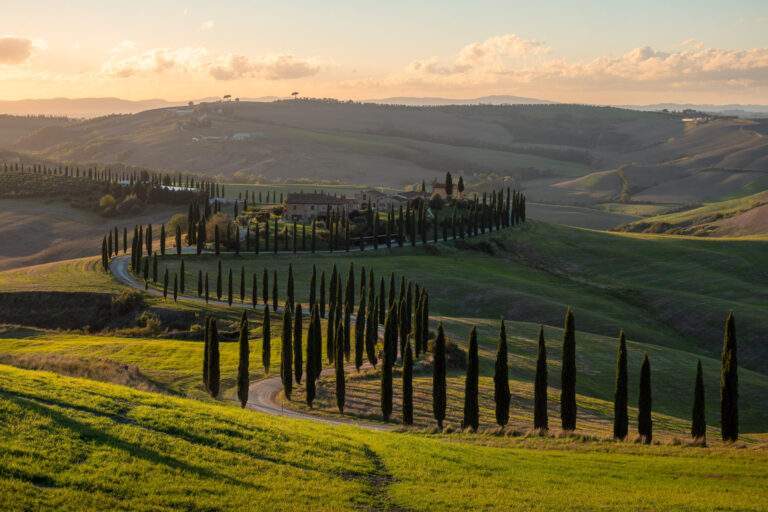
What to know before you visit the iconic Tuscany photo spot
Read moreBonus: Cinque Terre – Five colourful coastal towns
Technically, Cinque Terre (“the five lands”) is not in Tuscany but in the neighbouring region of Liguria – just across the border.
However, it’s one of Italy’s major highlights that shouldn’t be missed if you’re exploring Tuscany.
The five towns of Monterosso al Mare, Vernazza, Corniglia, Manarola and Riomaggiore each offer their own scenic charm by the sea.
Manarola and Riomaggiore are particularly famous for their colourful harbours.
It’s possible to visit all five towns on a day trip from places like Livorno, Lucca or Pisa. We did that ourselves. For those interested in hiking or exploring more thoroughly, it’s well worth spending a few days in the area.


Advertisement
Where to stay in Tuscany?
If you’re looking to experience a few select cities in Tuscany, we recommend settling in Florence, Siena, Pisa, Lucca or San Gimignano (or all five!).
Search for the cheapest and best accommodation:
The five mentioned above are, in our opinion, the best cities in Tuscany with many other hidden gems not far away.
If you want to explore all of the region, a Tuscany road trip is the ideal way to travel. That way you can spend 1-3 nights in each place before moving on.
This approach offers flexibility in choosing where to stay. You can often save money by staying in lesser-known towns – like our pleasant surprise in Radicofani along the way.
Alternatively, you can use a single location, such as a beautiful villa or hotel, as a base for (longer) day trips and adventures in Tuscany.
One of the best places to find luxurious villas in Tuscany is at Villa Finder (adlink). In addition to the stunning, curated properties, you’ll receive complimentary concierge services to assist with everything from pre-arrival grocery shopping to organising special celebrations.
Our personal accommodation recommendations from budget to luxury stays in Florence
Read moreOur recommendations for the best hotels in Pisa, Italy
Read moreOur recommendations for the best places to stay in Lucca, Italy
Read moreOur recommendations for the best places to stay in Siena, Tuscany
Read moreOur recommendations for the best places to stay in San Gimignano, Tuscany
Read moreValue for money hotels and bed and breakfasts in Tuscany
Finding good and affordable hotels in Tuscany can be challenging. However, you can often save money by staying just outside the historic city centres.
Here’s some inspiration for a few of the best value for money accommodations in Tuscany.
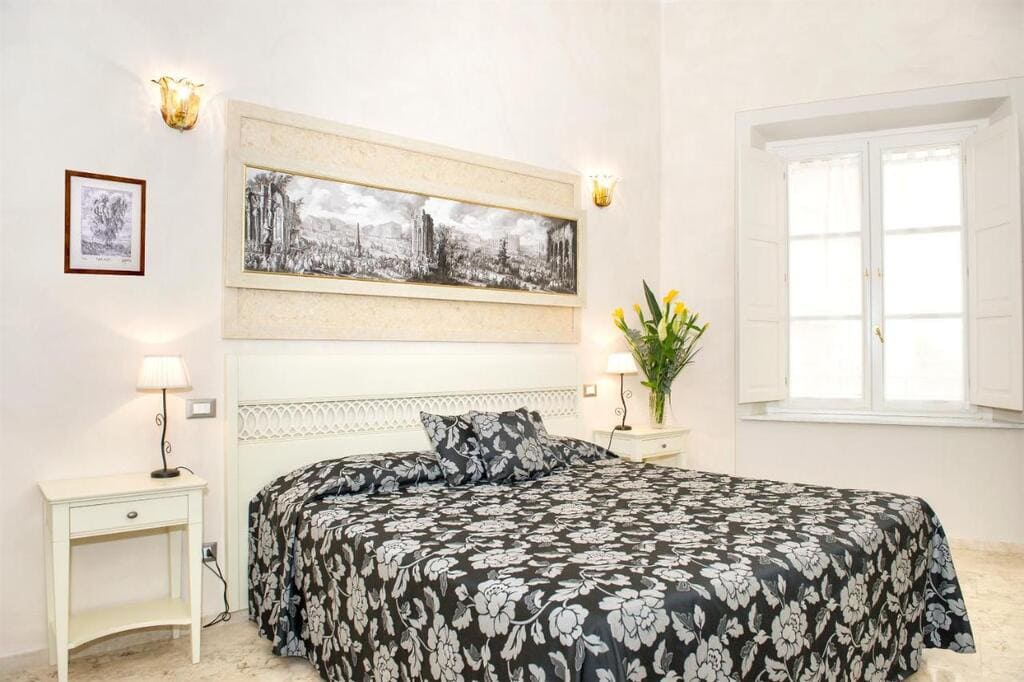
- Florence: Poggio Baronti B&B – Budget-friendly bed and breakfast that doesn’t compromise on quality, located just outside the centre of Florence.
- Siena: La Terrazza Sul Campo – Stay in the middle of Siena overlooking Piazza del Campo at a very reasonable price.
- Pisa: Relais dei Mercanti B&B and Suites – Cosy little place in the old town with excellent reviews (close to the Leaning Tower).
- Lucca: Villa Catelli B&B – Budget-friendly bed and breakfast conveniently located just outside the city wall. Perfect as a base for day trips to Pisa, Florence and Cinque Terre.



Luxury accommodation in Tuscany
Tuscany is filled with luxurious hotels and historic villas. They may not all be budget-friendly, but they offer the very best. And it’s always nice to dream, isn’t it?
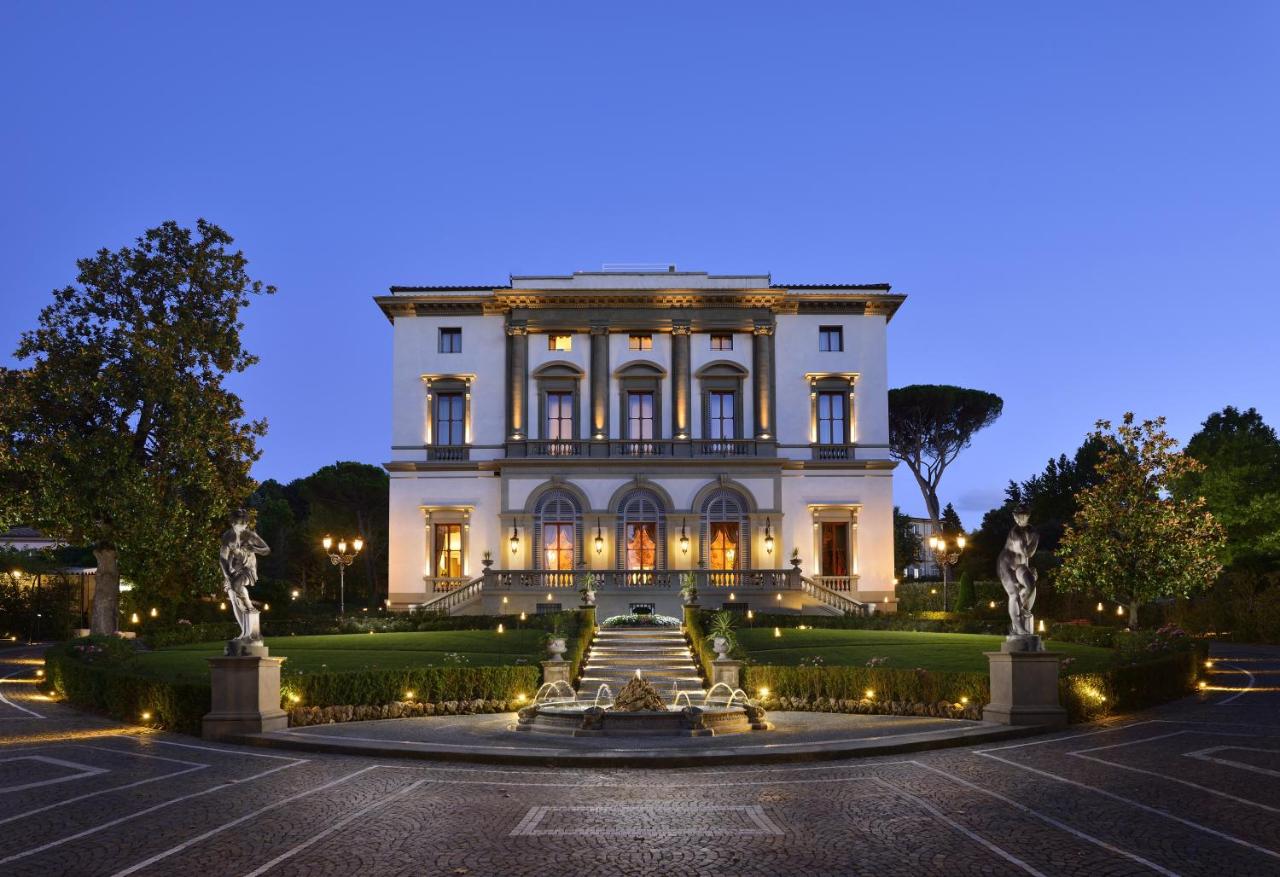
- Florence: Villa Cora – It is hard not to fall in love with this extravagant 19th-century villa (with a pool) south of the centro storico in pleasant Oltrarno.
- Siena: Grand Hotel Continental – The pinnacle of luxury in the heart of the city: the only 5-star hotel in Siena.
- Lucca: Grand Universe Lucca – Stay next to the central Piazza Napoleone in style.
- San Gimignano: Agrivilla I Pini – Aesthetic, ecological agriturismo with a pool just a 20-minute walk from San Gimignano.


When to visit Tuscany?
Tuscany can be visited year-round, but with significant seasonal differences, it’s wise to plan your trip accordingly.
The high season is in July and August when Italians, Europeans and much of the rest of the world enjoy their summer holidays.
July and August are also the hottest months, so if you have the flexibility to plan your trip to Tuscany outside of this period, we strongly recommend doing so.
June and September are ideal shoulder months with pleasant weather and fewer tourists (although it is always busy in Tuscany after all). April and May are also favourable, while October often sees sunny days that can be quite enjoyable.
December, January and February are the coldest months (like many other places in Europe).
It rains the most in September, October, November and December.

What to bring to Tuscany
- Travel insurance (adlink). Never travel without it!
- A good camera – here’s a guide to the gear we use.
- Sunscreen. Especially if you visit Tuscany in the summer period. We recommend an organic, vegan sunscreen without oxybenzone and other harmful chemicals.
- Sneakers or other types of shoes you can walk in comfortably.
- Swimwear and a towel if you plan to bathe in the thermal springs or stay somewhere with a swimming pool.
- A refillable water bottle.

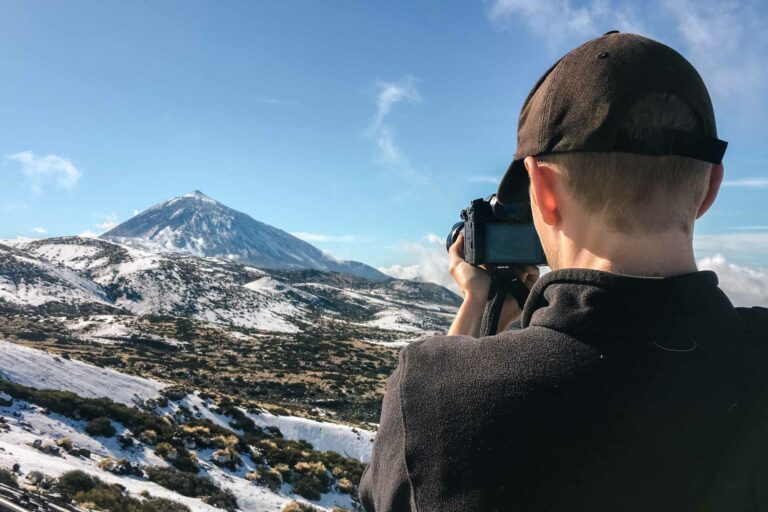
What camera, drone and accessories we use to capture life on the road
Read moreSustainable travel tips
To travel as sustainably as possible, we recommend the following:
- Book eco-friendly accommodation such as hotels with a sustainability focus or owned by locals.
- Minimise the use of air conditioning and turn it off when you are not in the room.
- Buy handmade souvenirs directly from the artist instead of mass-produced items in larger stores.
- Bring your own drinking water in a refillable bottle.
- Eat as plant-based, local and organic as possible.
- Avoid disposable plastics.
- Sort your waste correctly and do not throw it on the ground.
Thank you for reading along
Thank you for reading our travel guide to Tuscany with the best things to do and see. We hope it has been helpful!
What do you think of the best cities in Tuscany? Are you considering a Tuscany road trip through the rolling hills?
Don’t hesitate to ask us anything in the comments if you haven’t been to the region yet. We are happy to help.
If you’ve already been there, it would be great to hear your best tips and tricks.

More from Tuscany
We’ve put together our best travel guides to Tuscany – from city guides and where to stay to some of the region’s highlights.
City guides:
Where to stay:
Our favourite travel resources:
- Booking.com for hotels and apartments.
- Momondo for the best flight deals.
- AirHelp for flight delay compensation.
- GetYourGuide for great tours everywhere.
- Airalo for reliable eSIM.
- Discover Cars for transparent car hire.
- SafetyWing for travel insurance. We also like True Traveller. Compared here.

Where to Stay in Turin: Best Hotels from Budget to Luxury
Our recommendations for the best places to stay in Turin (Torino), Italy
-
Where to Stay in Bergamo: The Best Hotels in Città Alta & Città Bassa
Our recommendations for the best places to stay in Bergamo, Italy
-
Where to Stay in the Dolomites with Children: Best Family Hotels & Areas
Our recommendations for the best family-friendly hotels and areas in the Dolomites, Italy