

Travelling to Thailand with a baby
If you have a small baby and are thinking about travelling to Thailand, you’re far from alone.
Thailand is one of the world’s most popular countries to visit (with or without a baby!), and if you have parental leave, some extra holiday time or the chance to spend a longer period away from home, it’s a wonderful choice.
Whether you’ve been to Thailand many times before or it’s your first trip to Southeast Asia, you can look forward to a lovely holiday.
Beautiful beaches, delicious food and warm, welcoming people. The perfect combination.
We travelled to Thailand ourselves in mid-January with our 5-month-old baby, Adrian.
We spent two months on Phuket, Koh Samui and Koh Phangan, then another two months in Bali, before returning to Thailand to visit Chiang Mai, Koh Samet and Bangkok.
After welcoming our second child, we returned to Thailand for another extended family adventure in January and February.
This time, we travelled with 4-month-old Zoe and 2.5-year-old Adrian, exploring Ayutthaya and island-hopping in the Andaman Sea: Koh Mook, Koh Kradan, Koh Ngai, Koh Lanta, Koh Jum, Ao Nang (Krabi), Railay Beach, Phi Phi and Phuket.
In this guide to travelling to Thailand with a baby, we’ve gathered all of our tips and reflections to help you plan your own trip to the Land of Smiles with a little one.
Table of contents

Is Thailand a good holiday destination with a baby?
Are there easier destinations to visit with a small baby? Probably, yes.
The flight is long (depending on where you come from, of course), and the weather can get a bit too hot at times…
But can you still go to Thailand? Absolutely!
A holiday is just as much about the parents having a good time.
Your baby might not remember a thing about the trip, but they’ll definitely sense if you’re relaxed and happy – and that makes all the difference.
It’s such a treat not having to think about cooking, cleaning or laundry for a while.
And the best part?
Thai people adore children, so you’ll feel genuinely welcome wherever you go.

Is it safe to travel to Thailand with a baby?
The short answer is yes – Thailand is a safe country to visit with babies and children.
Thai culture is very family-oriented, and that warmth extends to travellers too.
Of course, it’s always wise to stay aware and use common sense, but most families find Thailand a very comfortable and welcoming place for a holiday.
One thing before we go on: We’re parents, not doctors. Everything in this guide is simply what worked for our family, and it isn’t medical advice. Talk to your own doctor, health visitor or a travel clinic before you go about vaccinations, mosquito protection and anything else specific to your baby.
The main things to be careful about are:
- Traffic: It can be chaotic, and scooters often weave in and out unpredictably.
- The sun: The UV index is high, so keep your baby well protected from the heat and sunlight.
- Mosquitoes: Dengue is present across Thailand, including the islands and cities in this guide. Avoid dense vegetation, stay indoors around dusk and dress your baby in light, skin-covering clothing.

Which island or city should you choose with a baby?
There are a few things worth considering when deciding where to stay in Thailand with a baby.
Before choosing a destination, it can be helpful to ask yourself a few questions:
- How much travelling are you comfortable with overall?
- Do you want to stay somewhere that’s easy to explore on foot?
- Is having a hospital or clinic nearby important to you?
- Are you looking for an authentic Thai atmosphere, or do you prefer the convenience of resort areas with pools and family-friendly facilities?
- How important is it to be close to supermarkets, pharmacies and other everyday conveniences?
The good news is that Thailand is a very baby-friendly destination. With a little research and some advance planning, most places can work well for families.
Below, we’ve shared our thoughts on some of the most popular destinations to visit in Thailand with a baby.
Bangkok
Bangkok with a baby can be great fun for a few days at the start or end of your trip, but you probably won’t want to spend your whole holiday in such a busy city.
From here, you can easily head to mainland cities or beaches like Hua Hin or Pattaya.
We spent the final four days of our trip in Bangkok, after a week on Koh Samet, which is a lovely little island that’s also fairly close to the capital.
On our second trip to Thailand with both children, we also visited the ancient city of Ayutthaya, just north of Bangkok. It’s an easy day trip from the capital, but we enjoyed staying for a few nights to explore the temples and historical sites at a more relaxed pace.

Everything you need to know about Thailand’s capital, including what to do, plenty of photos and our top tips
Read more
Everything you need to know, including what do, the best beaches, where to stay and our top tips
Read more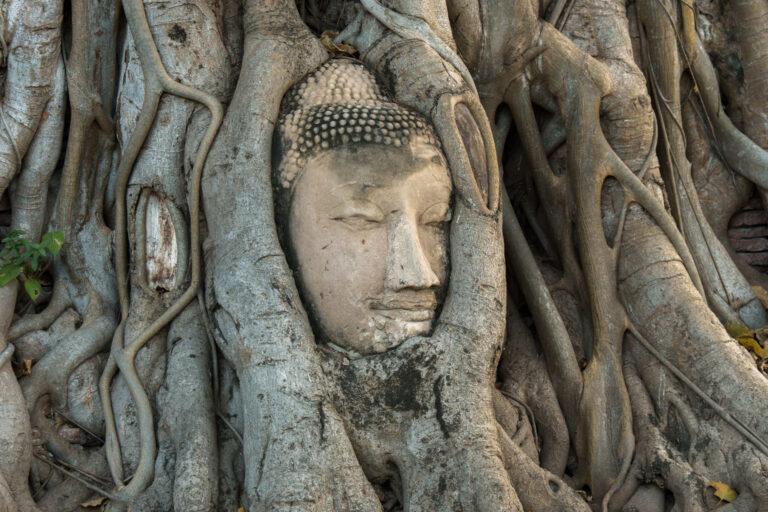
What to do in Ayutthaya, including temples, river views, sunset spots and when to visit
Read morePhuket
Phuket is a very touristy island (for better or worse), but if you venture beyond the busy resort area of Patong, you’ll find plenty of beautiful beaches and family-friendly places to stay.
We spent the first 18 days of our trip to Thailand with a baby on the island, and in our Phuket travel guide, we’ve shared everything you need to know for a great stay.
When we returned to Phuket with a baby (and a toddler) two years later, we stayed on the quieter side of the island in Cape Panwa and spent a few days on the stunning Naka Island (adlink), a short boat ride from Phuket’s northeast coast.
For more inspiration, read our guides to Phuket with kids and where to stay in Phuket with kids, including our favourite family-friendly areas, hotels and resorts.
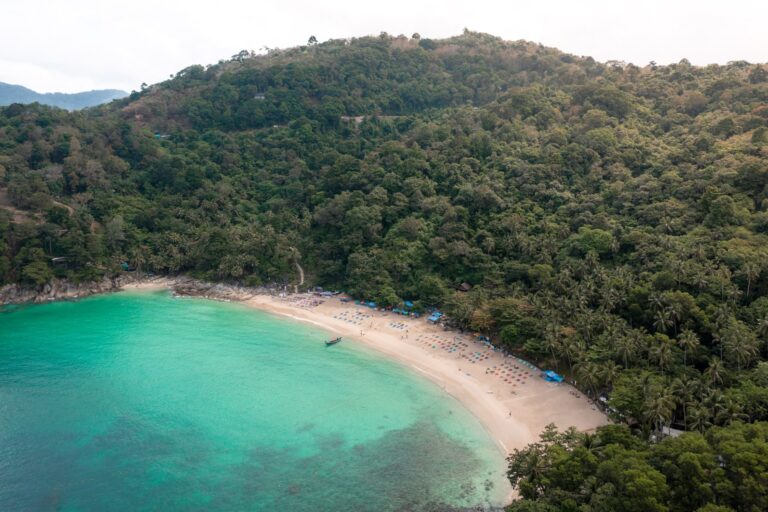
Everything you need to know about visiting Phuket, including what to see, things to avoid and our top tips
Read more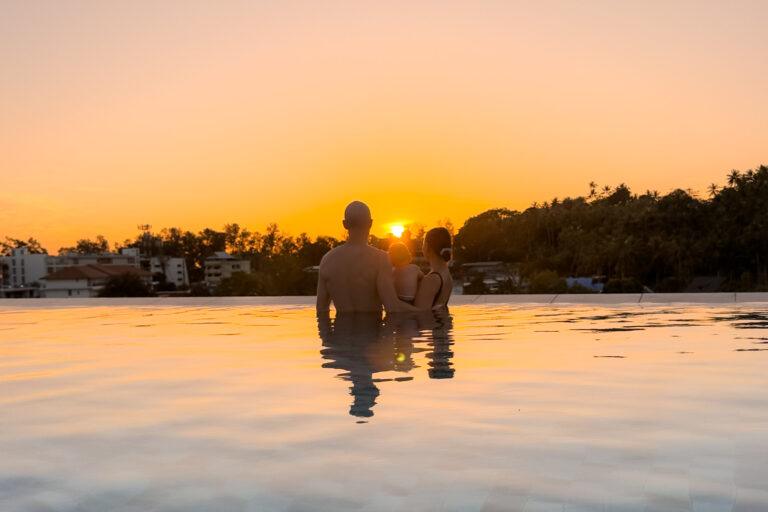
The best things to do with kids, where to stay as a family, which beaches to choose, and what to avoid – based on two family trips
Read more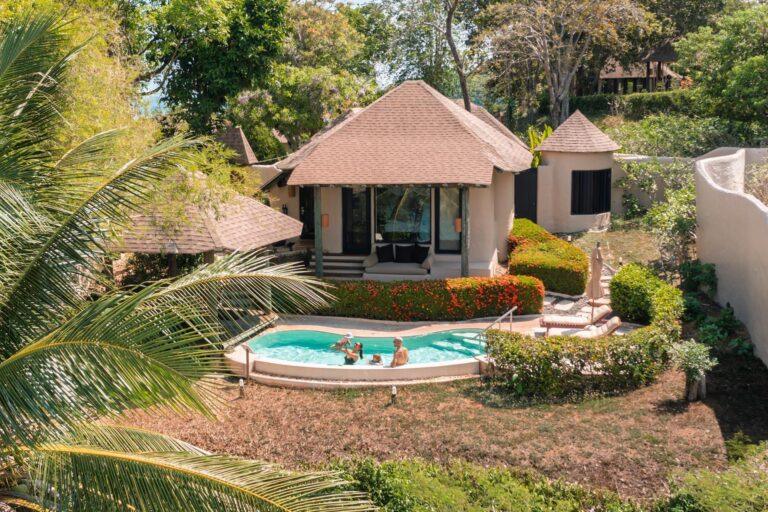
Our recommendations for the best family-friendly places to stay in Phuket, from relaxed beach bases to resorts with kids’ clubs
Read moreKoh Samui
There’s not much you can’t do on Koh Samui, Thailand’s second-largest island.
We’ve stayed here several times (including a few weeks with Adrian), and although the really touristy parts aren’t the most charming, you’re never far from somewhere quieter.
There are big supermarkets, several hospitals, an airport and a wide range of places to stay.
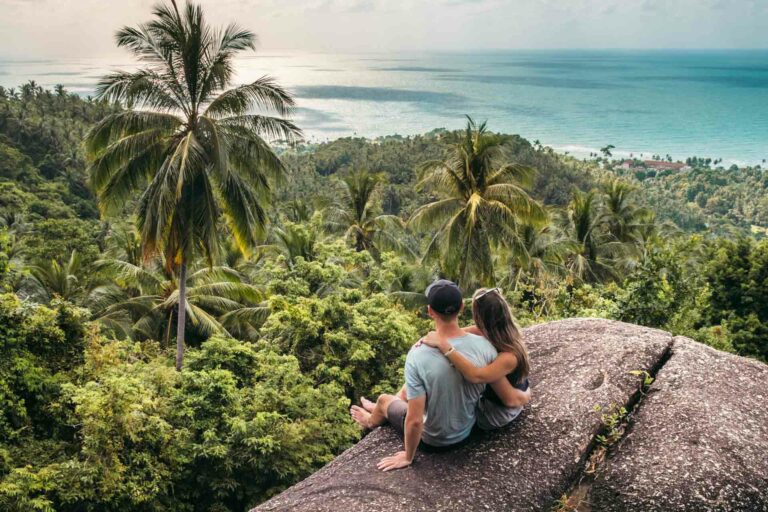
Everything you need to know including what to do, best beaches, where to stay and our best tips
Read moreKoh Phangan
We spent three weeks on Koh Phangan with Adrian, and we completely fell for the laid-back vibe in the hippie town of Sri Thanu on the west coast – full of vegan cafés, yoga spots and digital nomads. And the beaches are absolutely beautiful.
The rest of Koh Phangan is also very baby-friendly; just keep in mind that there are slightly fewer facilities than on nearby Koh Samui.

Everything you need to know including where to stay, what to do and where to eat in Koh Phangan
Read moreSouthern Thailand (the Andaman Sea)
From Bangkok, there are frequent flights to southern hubs like Krabi and Trang, which are both great starting points for visiting some of Thailand’s most beautiful beaches and islands.
We have now spent time in several of the most popular spots in this region, including Ao Nang and Railay Beach.
Both are quite touristy, but they are also veeery convenient, with plenty of family-friendly places to stay, easy access to hospitals and clinics, and all the everyday conveniences you might need when travelling with a baby.
We have spent a good amount of time on Koh Lanta, which has a relaxed, family-friendly atmosphere and is one of the most practical islands for travelling with little ones.
It has more infrastructure than many nearby islands, including a hospital, which adds extra peace of mind.
Koh Jum has a more local and low-key atmosphere, and though the beaches aren’t as pretty as on some of the other islands, it works well as an authentic stop between places like Koh Lanta and Krabi.
Further out at sea, we visited the Phi Phi Islands, which are stunning but much more remote. Being surrounded by ocean does mean you are further from major hospitals in Krabi or Phuket, although there are small clinics on the islands.
The boat transfer is often the part parents worry about most, as it can be bumpy, but it is absolutely manageable. We would recommend choosing a morning departure when the sea is typically calmer.
We also spent time on the more laid-back islands of Koh Mook, Koh Kradan and Koh Ngai.
These islands are wonderfully relaxed and easy to get around on foot, with a slower pace and a more unspoilt feel.
The trade-off is that you are further from larger hospitals and big supermarkets, so it is worth planning ahead and stocking up on essentials like nappies before you arrive.
For something a little more special, you can consider adding Koh Lipe to your trip.
It’s more remote and requires extra travel time, but the beaches are spectacular, and it has surprisingly good facilities for its size, so it works even with a baby if you don’t mind the journey.
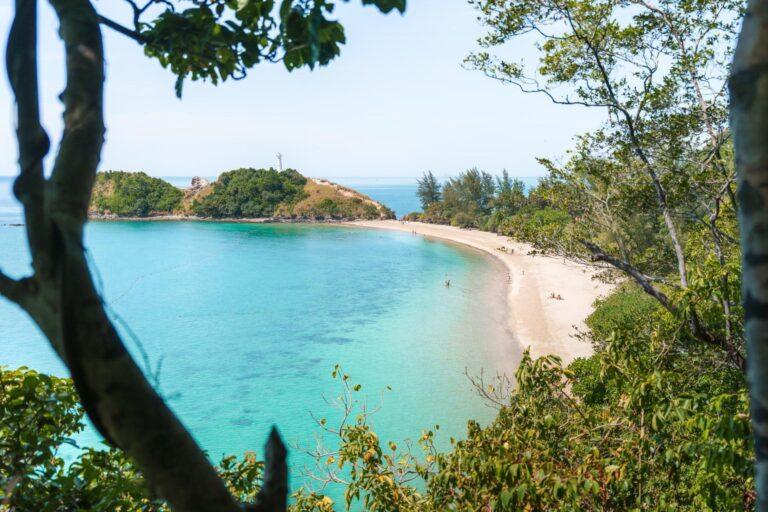
Everything you need to know about Koh Lanta in Thailand, including the best beaches, towns to see, what to do and our best tips
Read more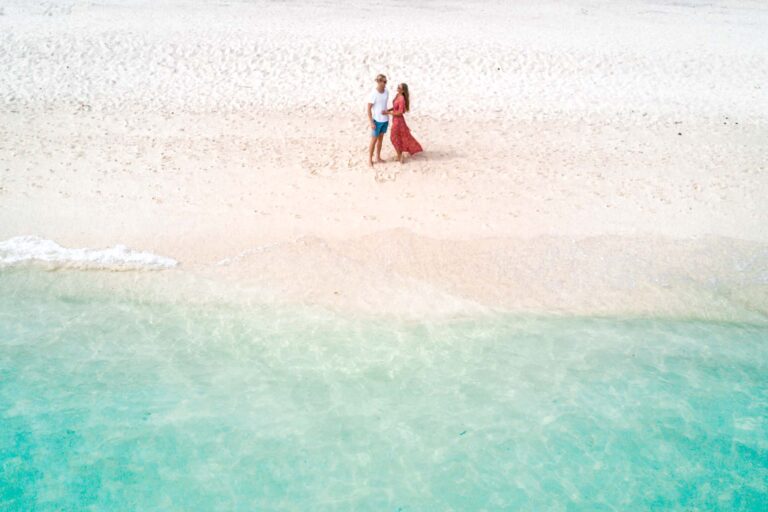
Everything you need to know about one of Thailand’s most beautiful islands, including the best beaches, where to stay and what to do
Read more


Weather in Thailand
When planning a trip to Thailand with a baby, it’s worth thinking about the weather.
The country has different seasons, and it would be a shame if it rained for most of your holiday because you ended up in the “wrong” part of Thailand at the wrong time.
Check out our full guide to when to travel to Thailand, which explains the seasonal differences across the country.
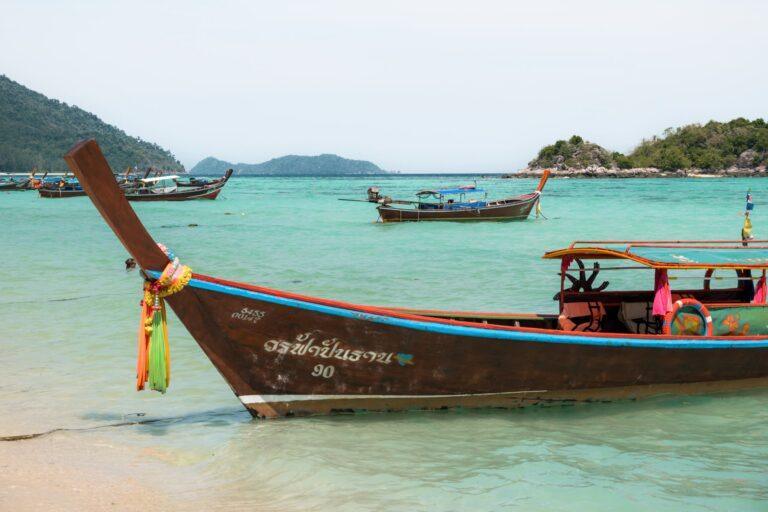
The best times to visit Thailand and what to expect – from the tropical islands to the northern hills
Read more16 tips for travelling to Thailand with a baby
Below, we’ve shared our best advice on what to think about before and during a trip to Thailand with a baby.
1. The flight
Whether you fly direct or have a stopover on the way to Thailand, it’s usually a long journey.
We had a long overnight flight ourselves, which worked out well because the baby slept most of the time. How much sleep we got is another story…
On many airlines, you can reserve the front seats with extra legroom and a wall.
These seats allow you to attach a baby bed, or “bassinet”, which usually fits babies weighing up to 9-12 kilos (~ 20-26 pounds), depending on the airline. Check with yours before booking.
The bassinet can only be used on seats with extra legroom, so on some airlines you need to pay to select them; on others, it’s free.
If you don’t book in advance, you might get lucky at check-in and secure a bassinet anyway, but there’s always the risk the bassinets are already taken.
We paid for the extra legroom in advance, which guaranteed a bassinet on our roughly nine-hour flight from Istanbul to Phuket.
It was absolutely worth it for us. Being able to put Adrian to sleep freed up our hands and even allowed us to take a little nap ourselves.
When we flew with baby Zoe, a bassinet seat wasn’t an option, so we carried her in a baby carrier for much of the flight instead.
It worked really well on the journey to Thailand, and she slept for a large part of the trip. On the flight back to Europe, however, not so much…
Every baby is different, so what works best will depend on your baby’s age, temperament and preferred way of sleeping.


2. Sun and heat
Thailand is warm all year round, which is lovely – especially compared with winter back in Denmark.
At the same time, the heat and humidity can be a lot for a small baby.
It’s great having them in just a nappy for plenty of skin-to-skin, but things can get sweaty very quickly.
The sun is strong, and small babies aren’t really meant to be in it at all. A little is impossible to avoid, of course, but it does make being outside during the day a bit tricky when the UV index is high.
Dress your baby in a sun hat and lightweight, long-sleeved clothing, or cover them with a thin blanket.
When temperatures reach 30°C (~ 86°F) or more, it can get very hot very fast.
Take regular breaks in the shade or indoors with air conditioning so neither you nor your baby overheats.
Babies get thirsty in the heat as well, so expect to feed more often than usual.
It’s definitely possible to enjoy the beautiful weather, but it’s worth thinking in advance about whether you’re prepared to stay mindful of the heat throughout the day.


3. Breathable clothing
If your baby won’t just be lying around in a nappy, it’s a good idea to choose lightweight, breathable fabrics like cotton or linen.
Try to avoid synthetic materials, which can trap heat and make your little one uncomfortable.

4. Type of accommodation
When your baby is sleeping, it can be really handy to have an extra room or a terrace to relax on.
Having more than one room meant we could put our son to bed in a dark bedroom while still keeping the lights on in another room to carry on with our own activities.
We stayed in a mix of hotel rooms with kitchens, studio apartments and villas with multiple rooms.
In a few places, we had only a single room, and it was fine as long as we were quiet at night, but it was definitely nicer to stay somewhere we could close the door on the sleeping baby.
Think about whether you’d like a full kitchen or a small kitchenette for preparing breakfast, other meals or baby food.
Most standard hotel rooms in Thailand have a small fridge.
We found it convenient to cook for ourselves sometimes (or order takeaway) so we didn’t have to go out with Adrian for every meal.
A sofa or other soft surface was handy for laying the baby down or for us to sit on while he slept in bed at night.
Tip: Bring a baby monitor if there’s a lot of space between rooms, if the doors close fully or if you plan to sit outdoors while your baby sleeps.


5. Baby bed and high chair
Many hotels let you borrow a baby bed, either free or for a small fee.
You can usually select this option when booking, but it’s a good idea to double-check that they actually have one suitable for your baby’s age.
If you’re co-sleeping, it can also be worth looking for a place with an extra-wide bed.
High chairs are often available to borrow, too, which is handy if you plan to feed your baby where you’re staying.

6. Air conditioning
It’s definitely worth paying a bit extra for a room or villa with air conditioning when travelling with a baby.
It makes it much easier to keep the temperature comfortable when you’re indoors.
Just be careful not to make it too cold – especially at night.
We usually kept the air conditioning set at a fairly high temperature and made sure the airflow was directed towards the ceiling or into the room, not straight at us.
7. Pool or beach
When we looked for hotels from home, we prioritised places with both a pool and easy access to the beach.
In the end, we mostly used the beach for afternoon or evening walks, or for a quick dip ourselves when Adrian was napping.
Even though we had a beach tent for shade, it just felt easier to be by the pool with a baby.
No waves, no salt water, no sand – and that made all the difference.
Sand gets everywhere, especially between those tiny baby fingers and toes!
Of course, it depends on your baby and where you stay. A calm beach might work perfectly for some.
But for us, having a pool at (almost) every stop was a huge win. Both our children loved splashing in the water, and it was such a fun part of our days.


8. Baby carrier or wrap
We (and our children) absolutely love our baby carrier, and it’s brilliant for travelling.
Your hands are free, your baby sits snug and secure against your chest, and they can fall asleep whenever they like.
In Thailand, it’s especially practical since pavements can be uneven or sometimes non-existent.
The only downside? You’ll definitely work up a sweat on your stomach!


9. What about a stroller?
Whether or not to bring a stroller really depends on your own needs (and your baby’s).
Some manage perfectly well without one, while others wouldn’t dream of travelling without it.
As mentioned earlier, pavements in Thailand aren’t always the best, and in some places, they don’t exist at all.
On the smaller islands, roads are often sandy, but in the cities and on larger islands like Phuket and Koh Samui, there are pavements in many areas.
On Koh Phangan, we could use our stroller in quite a few spots too.
We often saw people pushing strollers along the roadside instead of on the pavements, simply because it was less of a hassle than lifting them up and down all the time – so that’s always an option.
A stroller can be really useful for naps at restaurants or when your baby is tired after a day out.
Our stroller
We travelled with a Joolz Aer+ (plus a mosquito net and rain cover) during our 4.5-month trip to Thailand and Bali.
It’s honestly one of the best travel strollers out there.
The stroller is super quick to fold and unfold, feels solid, weighs only about 6 kilos (~ 13 pounds), fits as hand luggage and reclines almost completely flat.
Since Adrian couldn’t sit up on his own at the start of our trip (he was 5 months old then), this feature was excellent.
For most of the trip, we carried him in a baby carrier, as it was the easiest way for us to get around – so we might have managed without the stroller.
As he got a little older, he enjoyed sitting in it more, and it was lovely to be able to roll him to a café or restaurant when the pavements or roads allowed. We also found it really handy at airports.
All in all, we were happy to have it with us, but if your baby is still small or you’re not travelling for that long, it can definitely be freeing to leave the stroller at home.

10. Nappies/diapers and wet wipes
We brought a few nappies with us at the start, and once we ran out, we picked up more at the larger supermarkets on the islands we visited.
There was plenty to choose from, and luckily, we found some “hypoallergenic” options without perfume – it isn’t always easy, as scented products are very common in Thailand.
In the bigger supermarkets, we also found organic, fragrance-free wet wipes from MamyPoko.
In convenience stores like 7-Eleven or Tops Daily, you’ll mostly find small packs of nappies.
These are handy in a pinch, but if you’re away for a longer stay, it’s worth stopping by a larger supermarket such as Lotus’s or Big C.

11. Breastfeeding in public
On our trip to Thailand, we breastfed in a variety of public places and restaurants, and never once received any negative comments.
We were discreet, and we couldn’t say how it would feel to sit with completely bare breasts, as Thailand is fairly conservative about dress. Still, it felt quite comfortable.
At temples and other holy sites, shoulders and knees generally need to be covered.
Here, we made sure to find a more secluded spot whenever we needed to breastfeed on the go.

12. Mosquitoes
Mosquitoes are everywhere in Thailand, so it’s worth taking precautions.
Dress your baby in long sleeves and trousers when mosquitoes are active, especially early morning and around dusk.
Some say light-coloured or white clothing helps, though we can’t say for sure if that really makes a difference.
You can also stay indoors during peak mosquito hours, which is what we mostly did.
We may have missed a few beautiful sunsets, but we avoided getting bitten.
Finally, there is mosquito repellent made for babies. The minimum age differs between brands and even between countries, so it’s worth looking into properly rather than just going by the label. We didn’t use any ourselves, as we’d rather keep the harsher chemicals off a small baby. Instead we kept the children covered up and stayed in around dusk. That was our call, not a recommendation.

13. Bring a small pharmacy
If your child suddenly falls ill, it’s nice not to have to rush out and find a pharmacy, worry about opening hours, whether the staff speak English or which products are available.
Of course, pharmacies are widely available, but it can feel reassuring to have a small kit with you, just in case.
We have travelled with liquid baby paracetamol, disposable pipettes with sterile saline (saline drops), a thermometer, a nasal aspirator and some plasters.
We also packed zinc ointment for nappy rash and a baby-friendly factor 50 sunscreen (worth knowing that sunscreen isn’t officially recommended for babies under six months).

14. Remember travel insurance
It goes without saying, but it’s worth double-checking what your travel insurance actually covers.
Make sure your child is actively added to the policy (many insurers don’t include a new baby automatically) and that it specifically covers travel in Thailand.

We review and compare three different travel insurances that you can buy on the go
Read more15. Avoid planning too much
When travelling with a baby, it’s a good idea not to have a long list of attractions to tick off.
Babies are unpredictable; their moods can change in an instant, and their energy can run out sooner than you expect. And this goes for parents, too!
Feeding, nappy changes and naps can all vary from day to day, and routines can easily shift.
One of our most important tips for enjoying parental leave in Thailand is to keep things flexible and slow the pace.
Leave plenty of room for the trip to unfold on your baby’s terms.


16. Thais love children
It’s amazing how much attention you get from both men and women when travelling with a baby.
Thai people genuinely seem to adore children, and it’s common for men and women alike to smile and wave at little ones, chat to them and play with them.
At several restaurants and cafés, members of staff even offered to hold our baby, take him for a little walk or keep him entertained while we ate.
Not only did he love the extra attention, but it also gave us the chance to enjoy a meal together with both hands free for a change. A total win-win!

Have a great trip!
We hope our guide to travelling to Thailand with a baby has given you some inspiration for your own family adventure.
Hopefully, a few of our tips and experiences will help make your family holiday in Thailand a little easier to plan.
If you have any questions, feel free to leave them in the comments below. We’ll get back to you as quickly as we can.
And if you have your own tips or advice for travelling in Thailand with kids, we’d love to hear them!
Our favourite travel resources:
- Booking.com for hotels and apartments.
- Momondo for the best flight deals.
- AirHelp for flight delay compensation.
- GetYourGuide for great tours everywhere.
- Airalo for reliable eSIM.
- Discover Cars for transparent car hire.
- SafetyWing for travel insurance. We also like True Traveller. Compared here.

Where to Stay in Phuket With Kids: Best Family Hotels, Resorts & Areas
Our recommendations for the best family-friendly places to stay in Phuket, from relaxed beach bases to resorts with kids' clubs
-
Phuket with Kids: Best Beaches & Child-Friendly Things to Do
The best things to do with kids, where to stay as a family, which beaches to choose, and what to avoid – based on two family trips
-
Ayutthaya Travel Guide: 14 Best Things to Do in Thailand’s Ancient Capital
What to do in Ayutthaya, including temples, river views, sunset spots and when to visit


Hi, great article and tips! One question, how do you get around the cities, beaches etc with a baby? Just on your laps or you have rented a car with a car seat?
Hi Magda,
Thanks for your comment! We’re happy to hear you could use some of the tips.
We did a lot of walking and in Bangkok, we used the metro too. On the islands we got around by tuk-tuk or taxi. Some families with small children rent scooters, though that felt like a step too far for us – accidents are quite common in Thailand.
Taxis usually don’t have car seats, so when we did use them our baby travelled on us in a carrier in the back seat. If you book a private driver (for example for a longer day trip), it can sometimes be possible to borrow a car seat if you ask in advance, but it’s not always easy. You can of course bring your own car seat from home and secure it with a seat belt, but that means carrying it around everywhere 🙂
Hi loved this article! Did you need any vaccinations for your 4 month old? I’m going for 4 weeks with my baby, your article has made me feel less anxious about the trip!
Hi Lily, that’s lovely to hear! For Adrian, we followed the Danish childhood vaccination programme and consulted with our doctor before the trip. We’d recommend checking with your own doctor or a travel clinic too, as advice can vary depending on your itinerary and baby. We hope you have an amazing trip!