Expensive, but not totally out of reach
Can you visit Seychelles on a budget? The short answer is yes, as long as “budget” is understood in a Seychellois context.
Seychelles will never be as cheap as tropical destinations such as Thailand or Indonesia.
Accommodation costs more, many everyday products are imported and moving between the islands quickly adds up.
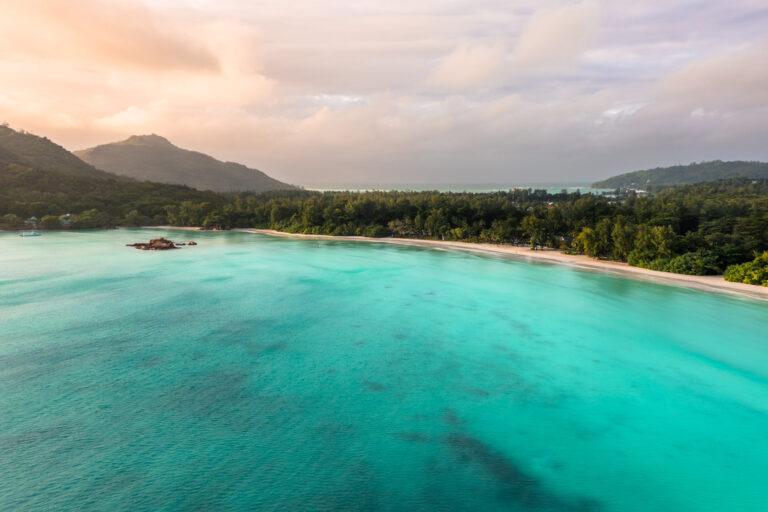
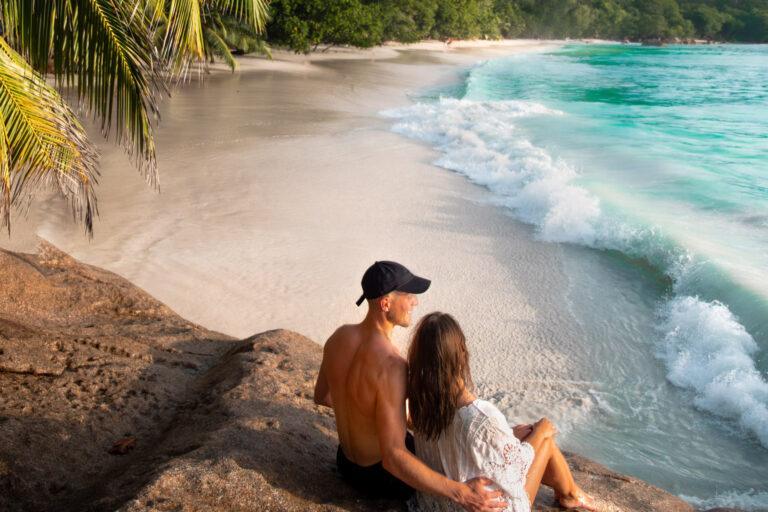
But you don’t come here for unlimited cocktails beside a private pool. Seychelles is all about the otherworldly beaches, green mountains, giant granite boulders and clear water.
And much of that is free once you arrive.
Stay in guesthouses, eat from takeaway shops, use buses and bicycles and choose your islands carefully, and a Seychelles holiday can cost much less than its luxury image suggests.
In this guide to visiting Seychelles on a budget, we share realistic daily costs, affordable places to stay and 22 practical ways to save money without missing what makes the country so special.
Search for the best hotels in Seychelles here (adlink).
Table of contents
- Is Seychelles expensive?
- Can you visit Seychelles on a budget?
- Can you go backpacking in Seychelles?
- How much does a trip to Seychelles cost?
- Is Seychelles expensive to eat and drink?
- Free things to do in Seychelles
- 22 ways to save money in Seychelles
- Budget accommodation in Seychelles
- Budget hotels on Mahé
- Budget hotels on Praslin
- Budget hotels on La Digue
- Is visiting Seychelles on a budget worth it?

Is Seychelles expensive?
Yes, Seychelles is expensive compared with many other tropical destinations.
The biggest expense is usually accommodation.
Island transfers, car hire, restaurant meals and imported groceries can also take a significant share of a Seychelles travel budget.
There is another side to the calculation, though.
Most beaches don’t require entrance fees, snorkelling from the shore can be free and some of the loveliest days consist of little more than walking, swimming and watching the sunset.
In other words, getting to Seychelles and sleeping there is expensive, but enjoying its greatest natural attractions doesn’t have to be.
Can you visit Seychelles on a budget?
You can visit Seychelles on a budget by building the trip around simple guesthouses or self-catering apartments rather than resorts.
Cooking some meals, eating at takeaway shops, travelling by bus and staying on fewer islands can reduce the total considerably.
Instead of simply looking for the cheapest room, consider what each choice does to the cost of the whole trip.
A room with a kitchen near a supermarket and bus stop may save more than a cheaper room up a remote hill.
It also helps to choose what matters most before you go.
Perhaps you’re happy to cook breakfast every day but want one boat trip. Perhaps you would rather visit two islands slowly than squeeze three islands and several ferry journeys into the same week.
Both are fair trade-offs. Staying somewhere simple doesn’t make the beaches any less beautiful.

Can you go backpacking in Seychelles?
Backpacking in Seychelles is possible, but it’s not a classic low-cost backpacker destination.
There is no extensive hostel circuit like the one you find in Southeast Asia, so a backpacking trip here usually means staying in modest guesthouses, sharing a self-catering apartment, using buses and eating simple meals.
Solo travellers tend to feel the cost of accommodation most because there’s nobody to split the room with. Travelling with a partner or friend makes it much easier to keep the per-person total down.
Mahé is the easiest island for keeping transport costs low thanks to its bus network.
Praslin also has buses, while compact La Digue is ideal for bicycles and walking.
A backpack can be convenient on ferries and transfers, but check current luggage rules before relying on public buses for airport or ferry-port journeys.
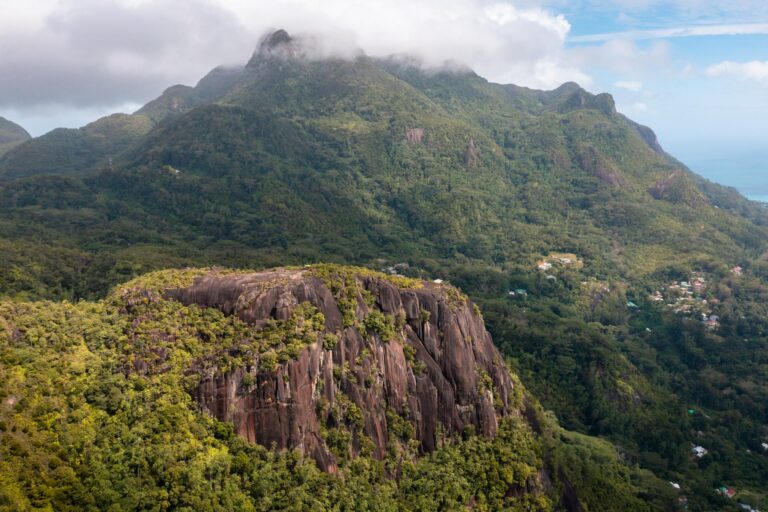
Everything you need to know about Mahé Island in Seychelles including what to do, when to visit, where to eat and where to stay
Read moreHow much does a trip to Seychelles cost?
Naturally, we can’t predict exactly how much your trip to Seychelles will cost, but we can give you a good idea of what to budget per day.
We haven’t included international airfares, as the price depends heavily on where you fly from, your dates and how flexible you can be.
The estimates below therefore cover costs after arrival, and they are per person per day when two people share a room.
Note that prices are from 2026, and they can change – particularly accommodation and transport, so use them as a guide rather than a promise.
How much does visiting Seychelles cost per day?
If you travel on a careful budget, expect to spend around 1,000 to 2,400 Seychellois rupees (SCR) (~ 60 to 143 EUR / 68 to 163 USD) per person per day.
Of that, approximately 650 to 1,500 SCR (~ 39 to 89 EUR / 44 to 102 USD) will go towards accommodation, though prices fluctuate with the seasons, of course.
Allow another 250 to 500 SCR (~ 15 to 30 EUR / 17 to 34 USD) for food and drinking water, 25 to 200 SCR (~ 1 to 12 EUR / 2 to 14 USD) for local transport and up to 100 SCR (~ 6 EUR / 7 USD) for activities.
Depending on where you stay, you may also need to pay an accommodation levy of up to 100 SCR (~ 6 EUR / 7 USD) per person per night. Small accommodation establishments are exempt.
This budget means choosing a simple guesthouse, cooking or eating takeaway food, using buses and filling most days with free activities.
Thankfully, spending the day on a ridiculously beautiful beach hardly feels like cutting back.
A budget for more comfort
If you want to keep the trip relatively affordable by Seychellois standards while staying somewhere a little more comfortable and enjoying a few restaurant meals, paid attractions or other experiences, budget around 2,300 to 5,100 SCR (~ 137 to 303 EUR / 156 to 346 USD) per person per day.
That includes roughly 1,500 to 3,000 SCR (~ 89 to 179 EUR / 102 to 203 USD) for accommodation, 500 to 1,000 SCR (~ 30 to 60 EUR / 34 to 68 USD) for food and drinking water, 200 to 500 SCR (~ 12 to 30 EUR / 14 to 34 USD) for local transport and 100 to 500 SCR (~ 6 to 30 EUR / 7 to 34 USD) for activities.
Again, the accommodation levy may add another 100 SCR (~ 6 EUR / 7 USD).
Obviously, you won’t spend exactly the same amount every day.
You might pay for a boat trip or hire a car one day, then spend the next swimming, hiking or lying on the beach for almost nothing.
That makes the overall average much more useful than trying to keep every single day within the same strict budget.

Costs outside your daily Seychelles travel budget
The following prices are from 2026:
- International flights: Highly dependent on dates and origin.
- Travel authorisation: The standard application currently costs about 160 SCR (~ 10 EUR / 11 USD) per adult through the official portal. It’s mandatory for all travellers entering the country.
- Mahé to Praslin ferry: Allow about 940 SCR (~ 56 EUR / 64 USD) each way in the main cabin, including the passenger port fee.
- Praslin to La Digue ferry: Allow about 260 SCR (~ 16 EUR / 18 USD) each way, including the passenger port fee.
- Paid nature attractions: Examples include Anse Source d’Argent through L’Union Estate at 150 SCR (~ 9 EUR / 10 USD), Copolia Trail at 100 SCR (~ 6 EUR / 7 USD) and Vallée de Mai at 450 SCR (~ 27 EUR / 31 USD).
The Tourism Environmental Sustainability Levy depends on the accommodation.
As of 2026, small establishments are exempt, while medium-sized accommodation charges 75 SCR (~ 5 EUR / 5 USD) and large accommodation, island resorts and yachts charge 100 SCR (~ 6 EUR / 7 USD) per person per night. Children aged 12 and under are exempt.
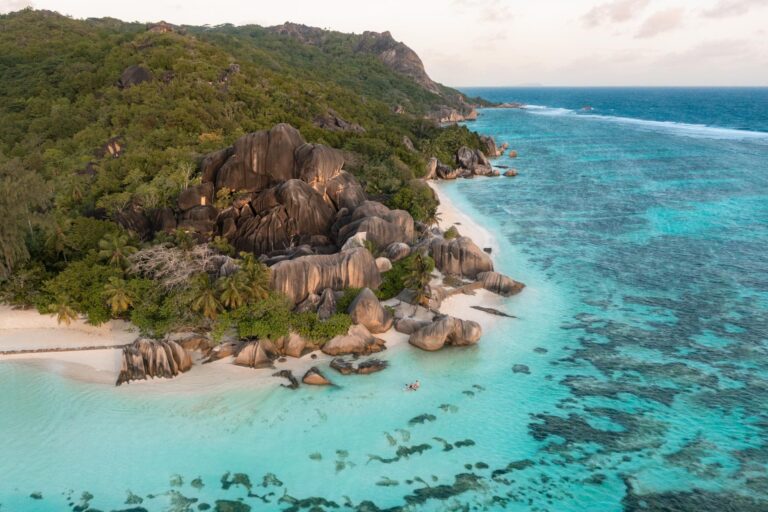
All you need to know about the famous paradise beach on La Digue, including how to get there, what to expect, where to stay and our best tips
Where to save and where spending more can make sense
Some parts of a Seychelles holiday are easier to cut back on than others.
Room size and resort facilities are obvious places to start.
If you plan to spend most of the day exploring or relaxing on the beach, you may not get much value from an enormous suite, several swimming pools or a long list of facilities you barely have time to find.
You can also save considerably on restaurant meals and imported drinks by eating at local takeaway shops, cooking some meals yourself and choosing water more often.
Private transfers and daily organised activities can quickly increase the total too. Public buses, walking and independent beach days may not sound quite as glamorous, but the beaches look exactly the same when you arrive by bus.
Before booking, consider whether you will actually use the luxury extras you’re paying for.
There is little point paying for a spa, gym and several hotel restaurants if your ambitious holiday plan mainly involves swimming, reading and deciding which beach to visit next.
That said, the lowest price is not always the cheapest choice overall.
A remote room that requires taxis or a rental car may end up costing more than a slightly pricier place close to the beach, shops and bus routes.
Likewise, a cheap room with no kitchen might lose its appeal once you add restaurant meals to the budget.
Transport is another area where saving a little can create a lot of inconvenience. A flight itinerary with a risky or exhausting connection may be cheaper, but beginning the holiday with a missed flight or an overnight airport stay is not much of a bargain.
Similarly, too many island changes in too few days mean paying for more ferries, transfers and luggage handling while spending less time enjoying the islands.
Finally, think carefully before choosing the ferry if you are very prone to seasickness.
It may cost less than flying between Mahé and Praslin, but the saving feels less impressive when you spend the entire crossing staring desperately at the horizon.

Everything you need to know about Praslin Island in Seychelles including what to do, when to visit, where to eat and where to stay
Read moreIs Seychelles expensive to eat and drink?
Eating and drinking in Seychelles can be expensive, but it’s also one of the easiest parts of the budget to control.
Eating out
A takeaway meal often costs around 80 to 150 SCR (~ 5 to 9 EUR / 5 to 10 USD), while a main course at a casual restaurant is more likely to be around 250 to 600 SCR (~ 15 to 36 EUR / 17 to 41 USD).
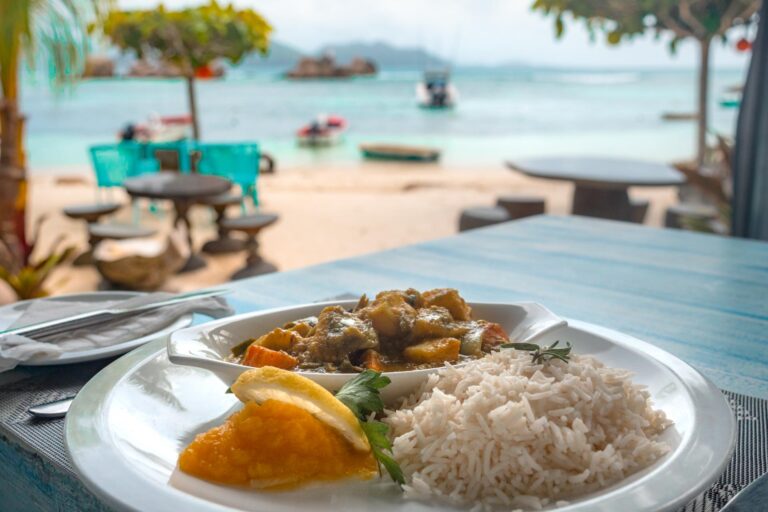
Takeaway shops serve filling curries, rice, noodles and vegetables at a fraction of the price of many hotel restaurants.
We often enjoyed this easy option on La Digue, sometimes taking dinner to the beach for sunset.

Supermarkets
Supermarket prices vary between islands and shops.
As a rough guide, a loaf of bread can cost 15 to 45 SCR (~ 1 to 3 EUR / 1 to 3 USD), a kilo of rice around 25 to 60 SCR (~ 1 to 4 EUR / 2 to 4 USD) and 1.5 litres of water around 15 to 35 SCR (~ 1 to 2 EUR / 1 to 2 USD).
Imported plant milk, snacks, alcohol and familiar branded products generally cost more.
Fresh fruit and vegetables can be reasonably priced when they are local and in season.
If you have a kitchen, a simple breakfast and a few home-cooked dinners make a noticeable difference over a week.

Everything you need to know about finding the most delicious vegan and vegetarian places in tropical paradise
Read moreFree things to do in Seychelles
The most reassuring thing about a Seychelles travel budget is that many of the country’s best experiences are free.
Spend the day at a public beach
Most beaches can be visited without an entrance fee.
Beau Vallon on Mahé, Anse Lazio on Praslin and the northern beaches of La Digue can all fill a wonderful day.
There are exceptions.
The usual route to the famous Anse Source d’Argent on La Digue passes through L’Union Estate (which has an entrance fee), and some beaches accessed through hotel grounds require advance registration.
Always check the current access arrangement before setting out.

Walk, hike and find the viewpoints
Seychelles has coastal walks, forest roads and viewpoints that can be explored without a guide.
Not every trail is free, so check whether an entrance fee applies. Copolia Trail, for example, is a paid trail.
Take heat, humidity and trail conditions seriously. Carry water, start early and only choose routes that suit your experience.
Explore Victoria and its market
It costs nothing to walk around the compact capital of Victoria on Mahé, see the clock tower and browse Sir Selwyn Selwyn-Clarke Market.
We also liked seeing a Hindu temple, a Christian church, a Chinese Pagoda and a mosque – all free.

Beach-hop around La Digue
La Digue is compact enough to explore under your own steam.
The northern coastal road connects several beaches, while the southeastern coast offers a wilder route for walkers who are prepared for the terrain.
A bicycle makes longer days easier, but walking is free and gives you time to notice the smaller details.
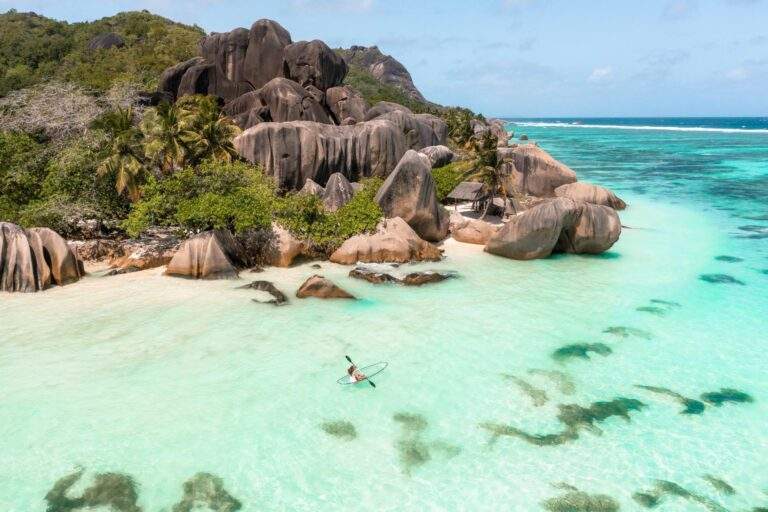
Everything you need to know about La Digue Island in Seychelles including what to do, when to visit, where to eat and where to stay
Read moreSwim, snorkel and watch the sunset
If you bring your own mask and snorkel, many shore swims cost nothing.
Conditions vary by beach and season, and some bays have strong currents or waves, so follow local advice and do not enter the water when it looks unsafe.
And hey, sunsets require no equipment at all!
Bring water, find a west-facing beach and enjoy the show.

22 ways to save money in Seychelles
The following money-saving tips follow your trip roughly from booking flights and choosing islands to packing your bags and keeping costs down once you arrive.
The biggest savings usually come from flights, island choices, transport and accommodation rather than saving a few rupees here and there. Still, the smaller costs add up too, so we’ve included them all.
1. Travel outside the busiest months
Flight and accommodation prices tend to rise when demand is highest, particularly around Christmas, New Year and popular European holiday periods.
Compare several weeks rather than assuming one month is always the cheapest.
Seychelles has a tropical climate throughout the year, but wind, rain and sea conditions vary, so balance the price against what you want to do.
2. Search for flights using flexible dates and routes
Searching a whole month can reveal a much cheaper departure day.
Also compare different stopovers, nearby departure airports and booking a separate flight to your departure airport if the connection still leaves a safe margin.
Always compare the final cost, including checked luggage, seat selection and any overnight stop.
Search for flights to Seychelles here (adlink).
3. Use the official website for your travel authorisation
When visiting Seychelles, all travellers entering the country must get a travel authorisation.
Apply through the official Seychelles government travel authorisation website.
Third-party services can look official while adding unnecessary handling fees.
The standard adult application currently costs about 160 SCR (~ 10 EUR / 11 USD).
Apply well in advance so there is no need to pay for faster processing.

Practical advice on entry requirements, island-hopping, costs, transport, beaches, safety and more
Read more4. Visit fewer islands
Every island change adds ferry or flight tickets, transfers and often a half-wasted travel day.
Two islands explored properly can be more rewarding than three islands rushed.
If the budget is tight, Mahé alone still offers beaches, mountain hikes, the capital of Victoria, local food and enough variety for a full holiday.

5. Take the ferry between Mahé and Praslin
The ferry is generally the cheaper alternative to flying between Mahé and Praslin.
Current main-cabin tickets cost about 940 SCR (~ 56 EUR / 64 USD) each way, including the passenger port fee, so it isn’t exactly cheap. But it’s still cheaper than flying.
Our crossing was rough, so saving money is not the only consideration if you’re very prone to seasickness. Conditions vary, but it’s worth being prepared.

6. Book inter-island transport with the operator
Check the ferry or airline’s own website before using a reseller.
This makes it easier to see the base fare, luggage allowance, change conditions and any port fee.
A reseller may still be useful, but comparing the total with the operator’s price helps you spot an avoidable booking charge.
7. Use public transport on Mahé and Praslin
Buses are far cheaper than hiring a car or taking taxis every day.
Routes are useful for many beaches and popular spots, but services can be slow and crowded.
Check the latest timetable (or ask at your accommodation) and make a different plan for large luggage if necessary.

8. Hire a car only for the days you need it
A rental car gives wonderful flexibility on Mahé and Praslin, but there is little reason to pay for it while spending full days near your accommodation or lounging at the beach.
We would recommend grouping distant beaches and viewpoints into one or two driving days, then using buses or walking on the remaining days.
Car hire on Mahé starts at around 800 SCR (~ 48 EUR / 54 USD)* per day for the cheapest options, though most rentals cost more.
If you plan to explore extensively, it can still work out cheaper than taking lots of taxis.
That said, the roads can be very steep and sometimes a little confusing to navigate.
Once you add the hassle of collecting the car, arranging insurance and paying for petrol, hiring a driver or using taxis may be worth the extra cost for some travellers.
*The price is from 2026. Rates vary between rental companies.

9. Walk around La Digue
On La Digue, the main town of La Passe, the ferry jetty, shops and several west-coast beaches are within walking distance of one another.
Staying in this area can reduce or even eliminate bicycle and transfer costs.
The heat is real, so carry water and avoid planning long walks in the middle of the day.

10. Compare multi-day bicycle rentals and what your hotel includes
A bicycle is the classic way to explore La Digue, and we enjoyed it ourselves when visiting the beaches further away from La Passe.
Consider renting a bicycle for one or two days of exploring, then walking for the rest of your stay to keep costs down.
Rentals are typically around 100 to 160 SCR (~ 6 to 10 EUR / 7 to 11 USD) per day, depending on the bicycle, with better daily rates sometimes available for several days.
Also, it’s worth asking whether your accommodation includes bicycles or offers a guest rate.
Remember to check the brakes, tyres, lights and lock before setting off.
We always take photos of anything we rent before using it, just in case, so we don’t end up paying for damage we didn’t cause.
We haven’t had any issues in Seychelles, but it’s a common scam in Southeast Asia, so we would rather be safe than sorry.

11. Choose guesthouses and self-catering apartments
Small guesthouses and apartments are the foundation of a realistic budget trip.
A simple double room often costs around 1,300 to 3,000 SCR (~ 77 to 179 EUR / 88 to 204 USD) per night, depending heavily on the island, location and dates.
You may have to give up a large pool, daily housekeeping or a beachfront restaurant.
In return, you can gain more space, a kitchen and contact with local hosts.
A kitchen makes it easy to prepare things like breakfast, sandwiches and simple dinners. You definitely do not need to cook every meal for the savings to become meaningful.
Tip: Make sure to check what “kitchen” actually means. A kettle and mini-fridge are useful, but they are not the same as having an oven, pan, knife and enough equipment to make dinner.
12. Book early while the affordable rooms are available
In Seychelles, there are fewer genuinely inexpensive rooms than luxury ones, especially in convenient locations close to beaches, shops or ferry connections.
Once they sell out, the remaining options can require either a much larger budget or expensive daily transport.
Booking early gives you the best chance of finding accommodation that suits both your plans and your wallet.
We usually use Booking.com (adlink) to compare accommodation, read guest reviews and access discounts through its Genius programme.

13. Compare the true cost of accommodation
When you’re researching different hotels, look beyond the headline nightly rate.
Check for taxes, the environmental levy, breakfast, airport or ferry transfers, bicycle rental and cancellation terms.
It’s also worth looking at the property on a map to see how close it is to bus stops, supermarkets, takeaway places and the sights you most want to visit.
A cheap room can quickly become less of a bargain if every day starts with a taxi ride, and a slightly more expensive apartment may work out cheaper overall if it includes breakfast, has a proper kitchen or means you will not need to rent a car.
On La Digue, staying near La Passe makes it easy to get around without motorised transport, while on Mahé, being close to a bus stop can be more useful than a sea view if you’re not hiring a car.
14. Ask about longer-stay discounts
If you’re staying on one of the islands for a longer period, it may be worth politely asking for a small discount.
Smaller guesthouses may offer better rates for a week or more, particularly outside the busiest periods.
Ask before booking, but never assume a discount is available.
A longer stay can also lower the average cost of transfers, bicycle delivery and stocking up on kitchen basics.
15. Cook some of your own meals
When travelling to Seychelles on a budget, food is one of the highest day-to-day costs to consider.
Restaurant bills can make your spending add up surprisingly quickly, so breakfast and dinner are often the easiest meals to save on.
Porridge, fruit, bread, rice, pasta and a simple vegetable curry need very little equipment to prepare.
We ate out a lot during our two weeks on the islands, but we also used the shared kitchen at Petra’s Guest House (adlink) on La Digue to cook some of our meals.
It gave us a welcome break from finding and paying for restaurant food every day.
16. Buy local produce and simple staples
When cooking for yourself, keep meals simple with rice, pasta, bread and whichever local fruit and vegetables look good.
This is one of the easiest ways to stop food prices from taking over your travel budget.
Imported snacks and specialist products are where a small basket can suddenly become surprisingly expensive.
Compare prices at a proper supermarket rather than relying on the smallest convenience shops. On La Digue, we found the main supermarket particularly useful for self-catering.

17. Eat at takeaway shops
If you need a break from cooking for yourself or simply fancy a small treat, local takeaway shops are a great middle ground between supermarket meals and sit-down restaurants.
They are usually much cheaper than restaurants, portions can be generous, and the daily selection often includes vegetable curries, lentils, rice and noodles.
Popular dishes can sell out, so it is best to go earlier rather than expect the full selection late in the evening.

18. Fill up on water and choose it over imported drinks
This may be obvious, but what you choose to drink can have a big effect on your travel budget.
Imported soft drinks, juice, wine and beer can quickly turn a modest food budget into a much larger one.
Bring a reusable bottle and make water your default drink.
Tap water is generally safe to drink on the main islands, though the taste is not always to everyone’s liking.
Ask whether your accommodation offers filtered drinking water or a refill point. If not, buying larger containers is usually cheaper per litre than picking up a small bottle whenever you’re thirsty.
At restaurants, opting for filtered water is also a much more budget-friendly choice than alcohol or imported soft drinks.
19. Make the free beaches your main activity
You could spend heavily on an excursion every day, but Seychelles doesn’t demand it.
Plan generous beach days and let one or two paid experiences stand out.
Read about access, currents, shade and facilities beforehand. The best free beach is generally one you can reach safely without an expensive taxi.

20. Bring your own snorkelling equipment
If you already own a mask and snorkel that fit well, bring them along.
It saves on repeated rental costs and means you can jump into the water whenever a tempting patch of turquoise appears.
We would not buy bulky snorkelling gear just for one trip, though, without checking the luggage costs first.

21. Bring sunscreen, mosquito repellent and toiletries from home
Many toiletries are imported, and resort or convenience shops are rarely where you want to discover that the sunscreen is empty.
We recommend that you pack enough reef-conscious sunscreen, mosquito repellent and everyday toiletries for your trip.
22. Choose the cheapest way to pay and get Seychellois rupees
There is no single best payment method for everyone, but a quick look at your bank’s foreign-transaction fees, cash-withdrawal charges and exchange rate before leaving home can save on unnecessary holiday costs.
When a card terminal or ATM offers to convert the amount into your home currency, choose to pay in Seychellois rupees instead. This avoids a less favourable exchange rate.
Also, keep some local cash for small businesses, buses and the occasional coconut stop.

Budget accommodation in Seychelles
Budget accommodation here usually means guesthouses, apartments and self-catering chalets.
It rarely means dorm beds or truly cheap beachfront hotels.
A simple double room usually sits in the 1,300 to 3,000 SCR band (~ 77 to 179 EUR / 88 to 204 USD) per night.
A more comfortable independent hotel or well-located apartment can cost 3,000 to 6,000 SCR (~ 179 to 357 EUR / 204 to 408 USD) per night.
Dates, island and cancellation terms make a big difference.
Look for a usable kitchen, somewhere to refill a water bottle, breakfast, a nearby bus stop and shops within walking distance. On La Digue, included bicycles can also change the calculation.
Check the final price with all taxes and any environmental levy.
Common compromises include a hillside setting, basic décor, fewer services and a location away from the best-known beaches.
None of those is necessarily a problem, but a remote bargain can become expensive if it requires a car or taxi every day.
Below, we share some of the best budget hotels in Seychelles, with options for each island.
Search for the best budget hotels in Seychelles (adlink).
Budget hotels on Mahé
Mahé has the largest selection of accommodation and the best public transport network.
A good base can make it possible to combine bus days, beach days and just a few days with a rental car.
Read our full guide on where to stay on Mahé.
Chez Batista Villas
Chez Batista Villas sits right on Anse Takamaka, giving you a beautiful beach without paying for daily transport to reach it.
It’s not the most budget-friendly option on the island, but it’s great value for money. The rooms have air conditioning and private bathrooms, and there’s a swimming pool.
It’s a particularly appealing value choice if beach time is the priority.
Weigh the secluded setting against the cost of getting to shops and other parts of Mahé.
Check prices and availability at Chez Batista Villas (adlink).

La Nature Apartments Au Cap
La Nature Apartments Au Cap offers spacious apartments with air conditioning and a private kitchen. That combination makes it easier to save on both the room and meals.
The east-coast location is relatively central for exploring Mahé, especially with a rental car. Check the bus connection if you plan to rely entirely on public transport.
Check prices and availability at La Nature Apartments Au Cap (adlink).

Tropical Garden Self Catering
Tropical Garden Self Catering is located in the mountains away from the busier coast.
The apartments include air conditioning, balconies and kitchens.
A nearby bus stop helps if you don’t hire a car, but study the timetable and terrain before booking. The peaceful setting is good value only if it works with your transport plan.
Check prices and availability at Tropical Garden Self Catering (adlink).

Villa Kayola – Self Catering
Villa Kayola is close to the airport on Mahé as well as Anse aux Pins.
The bright apartments have air conditioning, balconies and small kitchens for uncomplicated meals.
The airport location may reduce transfer costs at the beginning or end of the trip. As the property is elevated, check access if hills or heavy luggage are a concern.
Check prices and availability at Villa Kayola – Self Catering (adlink).

Anse Soleil Beachcomber Hotel and Self Catering
Anse Soleil Beachcomber combines a fine beach location with a choice of accommodation. The self-catering chalets sit up the hill, while other rooms are closer to the sand.
This is more of a value-for-location option than the cheapest bed on Mahé.
Staying beside Anse Soleil can still make financial sense if you want quiet beach days and don’t plan to travel around the island constantly.
Check prices and availability at Anse Soleil Beachcomber (adlink).

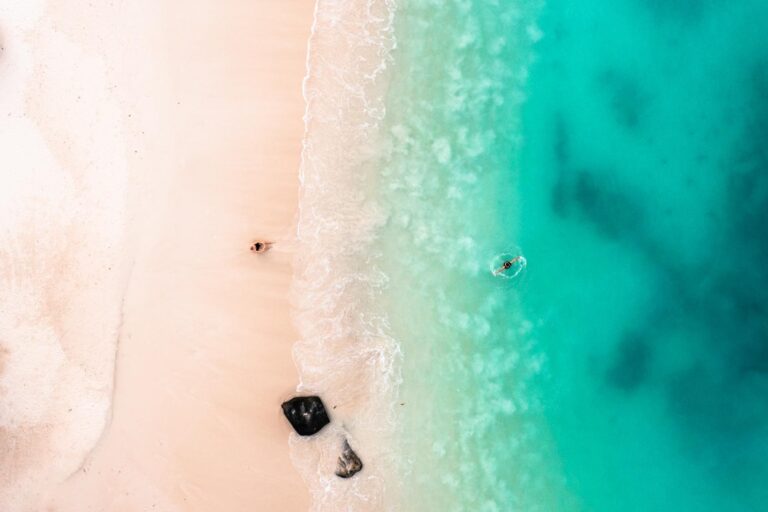
Our personal recommendations for the best areas and places to stay
Read moreBudget hotels on Praslin
Praslin has fewer genuinely cheap options, and some of the recommendations below are best understood as value for money rather than low-cost hotels.
Location near a bus route, beach or supermarket is particularly important.
Read our full guide on where to stay on Praslin.
Le Chevalier Bay Guesthouse
Le Chevalier Bay Guesthouse is right on Anse Lazio, one of Praslin’s (and Seychelles’!) most beautiful beaches.
That rare position is the main reason to consider it.
It’s a value-for-location choice rather than a conventional budget guesthouse. We think a higher room rate may still work on a budget if your priority is spending several days at Anse Lazio without repeated transport around the island.
Check prices and availability at Le Chevalier Bay Guesthouse (adlink).

Les Lauriers Eco Hotel
Les Lauriers Eco Hotel is right by Côte d’Or, putting the long beach, restaurants and local services within easy reach.
With such a convenient location, staying here can reduce the need for taxis or a full-time rental car.
The hotel has a pool and more facilities than a basic guesthouse, so it does belong in the value-for-money category.
Check prices and availability at Les Lauriers Eco Hotel (adlink).

Exotic Guest House
Right next to the beautiful Anse Volbert, Exotic Guest House offers self-catering apartments.
The simple kitchen and views over the bay make it a useful option for keeping food costs under control without giving up a convenient beach area.
As with any Praslin stay, check the exact walking route, bus access and what’s included before comparing the final price.
Check prices and availability at Exotic Guest House (adlink).

Hotel Plein Soleil
Hotel Plein Soleil is a relaxed option in the Grand Anse area with a swimming pool and tropical surroundings.
Grand Anse is useful for shops, buses and the airport side of the island.
Seasonal seaweed can affect the west-coast beaches, so the location may suit travellers planning to explore Praslin rather than stay on one beach.
Check prices and availability at Hotel Plein Soleil (adlink).

La Résidence d’Almée Guesthouse
If you’re looking for a simple option in the Baie Sainte Anne area, La Résidence d’Almée Guesthouse is well placed for the ferry terminal and local services.
The practical location may be especially useful for a short Praslin stay or an early ferry.
It’s not a classic beach hotel, so compare convenience with how often you expect to travel to the island’s best-known beaches.
Check prices and availability at La Résidence d’Almée Guesthouse (adlink).

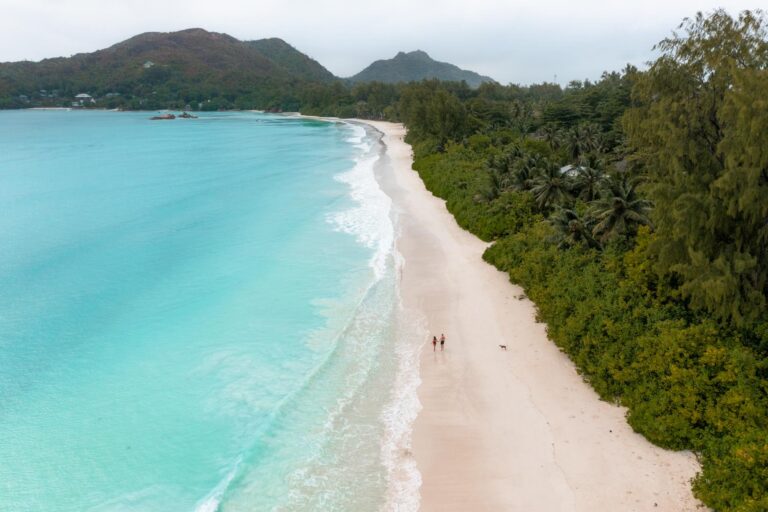
Our personal recommendations for the best areas and places to stay
Read moreBudget hotels on La Digue
La Digue has no public bus network and very little motorised visitor transport.
The location of your accommodation therefore affects bicycle costs, walking time and access to shops.
Read our full guide on where to stay on La Digue.
Hotel L’Ocean
Hotel L’Ocean is at the northern end of La Digue near Anse Sévère and tiny Anse Patates. Rooms have air conditioning and private bathrooms.
The location is excellent for the northern beaches, but farther from the ferry jetty and main supermarkets.
Include bicycle rental in the total unless you’re happy to walk.
Check prices and availability at Hotel L’Ocean (adlink).

Villa Des Flots
Around 2.5 kilometres from town, Villa Des Flots has a secluded beachfront position on La Digue’s northeast coast.
It’s a peaceful choice for travellers who want to slow down.
The trade-off is being farther from the ferry, shops and many restaurants, so plan food and bicycle costs before choosing the lower room rate.
Check prices and availability at Villa Des Flots (adlink).

Zanboza Guesthouse
Zanboza Guesthouse is on the way towards the island’s wild east coast, just beyond the main settlement.
Its position gives fairly direct bicycle access to both sides of La Digue.
The guesthouse is up a hill, which rewards guests with views but may not suit everyone in the heat. Consider the climb before treating the room as a straightforward bargain.
Check prices and availability at Zanboza Guesthouse (adlink).

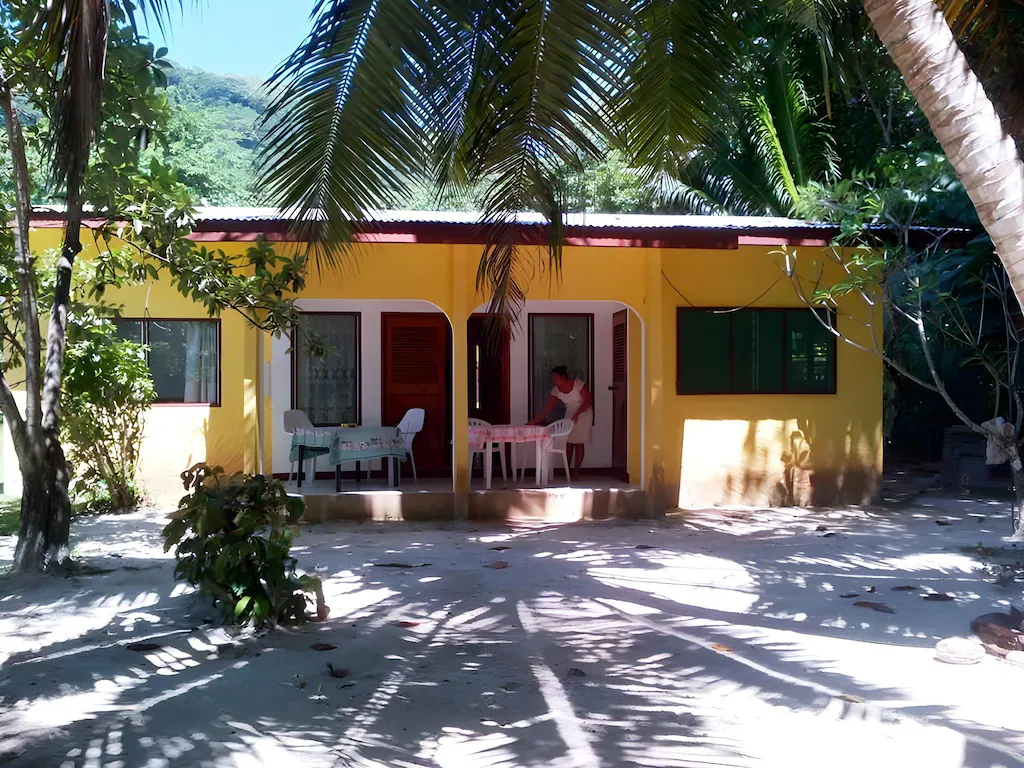
Petra’s Guest House
After a few days at the lovely, more polished Le Repaire Boutique Hotel (adlink), we stayed at Petra’s Guest House and used the shared kitchen to cook some meals.
It’s a simple guesthouse in La Passe, within easy reach of shops and the ferry area.
There’s a shared kitchen and air conditioning in some rooms, and you can rent bicycles.
It’s one of the more inexpensive places to consider on La Digue, particularly if cooking and a central location matter more than hotel facilities.
Check prices and availability at Petra’s Guest House (adlink).
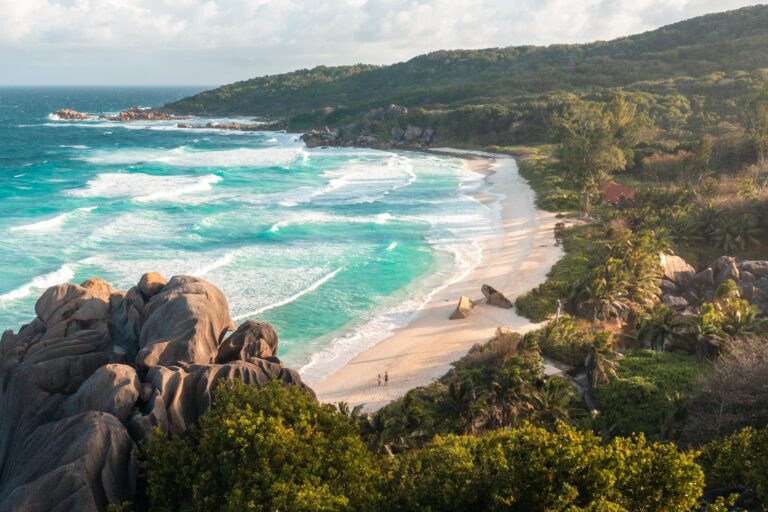
Our recommendations for the best areas and places to stay (from budget guesthouses to luxury hotels)
Read moreIs visiting Seychelles on a budget worth it?
Yes, we definitely think so, but you have to accept that Seychelles on a budget is still not an ultra-cheap holiday.
The sensible compromises are a simple room, fewer restaurant meals, buses instead of taxis and potentially more time on fewer islands.
Be aware that the cheapest-looking option can backfire if it means staying in an inconvenient location, enduring long connections or paying for transport every day.
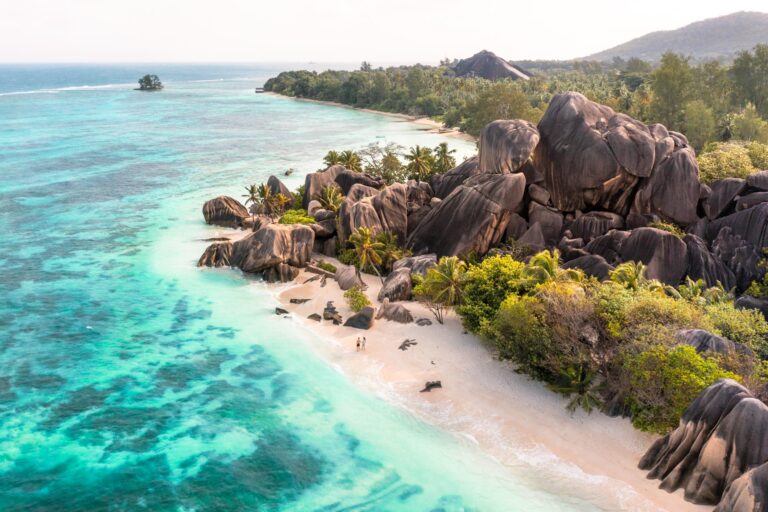
What makes the trip worthwhile is that Seychelles’ greatest luxury is the landscape itself.
A public beach at sunset offers the same granite boulders, soft sand and warm Indian Ocean whether you return to a guesthouse or a five-star resort.
Start with the costs you cannot avoid, choose one or two experiences worth paying for and leave plenty of room for the free days.
That is how Seychelles stays expensive but doable, rather than simply out of reach.

Everything you need to know including the best beaches, hikes & activities, which islands to visit, 1-2 week itineraries and where to stay in Seychelles
Thanks for reading our guide to visiting Seychelles on a budget
Visiting Seychelles on a budget does not have to mean missing out on the experiences you came for.
A simple guesthouse, local takeaways, buses and plenty of beach time can take you surprisingly far.
If you have any questions about trip costs, budget accommodation in Seychelles or saving money on the islands, let us know in the comments. We would also love to hear your own budget tips.
However you decide to spend and save, we hope you have a wonderful time in Seychelles!
Our favourite travel resources:
- Booking.com for hotels and apartments.
- Momondo for the best flight deals.
- AirHelp for flight delay compensation.
- GetYourGuide for great tours everywhere.
- Airalo for reliable eSIM.
- Discover Cars for transparent car hire.
- SafetyWing for travel insurance. We also like True Traveller. Compared here.

Seychelles Travel Tips: 42 Things to Know Before You Go
Practical advice on entry requirements, island-hopping, costs, transport, beaches, safety and more
-
The Best Luxury Hotels in Seychelles: Resorts, Villas & Private-Island Stays
Our recommendations for five-star beach resorts on Mahé, Praslin and La Digue + private-island pool villas.
-
Seychelles Honeymoon Guide: Romantic Hotels, Costs & Itinerary Ideas
Plan a Seychelles honeymoon across Mahé, Praslin and La Digue with all of our tips