
A church covered in sand – or is it?
The Sand-Covered Church is one of the most popular tourist spots in Skagen.
Located in the northernmost part of Denmark in Jutland, the historic landmark is also known as the Sand-Buried Church, the Old Skagen Church or Sct. Laurentius Church (in Danish: Den Tilsandede Kirke or Sankt Laurentii Kirke).
From the name alone, you’d expect a church buried under the sand, right?
That’s at least what we were expecting!
But we hadn’t really done our research before visiting, and since you are reading this now, you will be better prepared than we were:
The Sand-Covered Church is just a church tower standing among sand dunes.
However, it’s still a historical site in Skagen that’s worth a visit!
In this travel guide to the Sand-Covered Church in Skagen, we’ll tell you why you should visit, how to visit, where to stay and our best tips for experiencing the unique church in Denmark.
Where to stay near the Sand-Covered Church in Skagen?
- Budget: Hotel Marie – Keep the price down with shared bathrooms.
- Value for money: Skagen Strand and Holiday Center – The perfect place for families.
- Luxury: Skagen Hotel – Great location and stylish rooms.
Search for the best and cheapest hotels near the Sand-Covered Church here.
Table of contents
- Why visit the Sand-Covered Church
- What to expect at the Sand-Covered Church
- Practical information about the Sand-Covered Church
- Where to stay near the Sand-Covered Church
- Where to eat near the Sand-Covered Church
- Our best tips for visiting the Sand-Covered Church
- What to bring to the Sand-Covered Church
- Minimise your impact
- FAQ about the Sand-Covered Church in Skagen

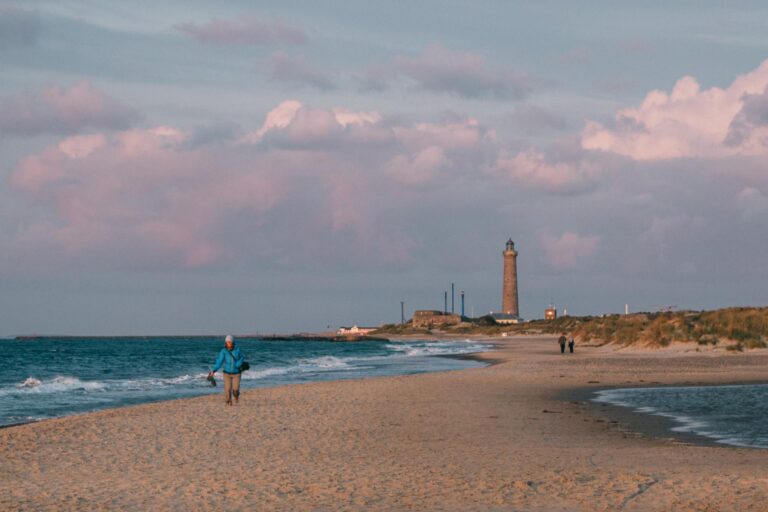
Everything you need to know about Skagen in North Jutland, including why you should visit, what to do, where to stay and our best tips
Why visit the Sand-Covered Church
As we already revealed in the intro, the Sand-Covered Church is actually only a church tower today.
But visiting the landmark in Skagen still offers an interesting experience that combines history, nature and cultural intrigue.
The original brick church dates back to the late 14th century, and at that time, it was the largest church in Vendsyssel.
The church tower with a crow-stepped gable is believed to have been built around the year 1500.
The name of the church
During the latter part of the 18th century, the church found itself gradually engulfed by sand originating from the neighbouring sand dunes.
With every service, the congregation had to painstakingly excavate the entrance, contending with an ongoing battle to preserve the church’s sanctity against the encroaching sand – hence the name Sand-Covered or Sand-Buried Church.
This tireless endeavour to maintain the church’s accessibility persisted until 1795, ultimately leading to its abandonment.
The nave itself has long since been demolished, and now the only remains of the original structure are the church tower.

Everything you need to know about the long sandbar at Skagen Odde including what to do, where to stay and our best tips
Read moreThe architecture
The initial design of Sct. Laurentius Church featured an elongated vaulted nave, spanning approximately 45 meters in length.
Crafted in the Gothic architectural style, the church was predominantly constructed using bricks sourced from the Netherlands and Germany, particularly from the city of Lübeck.
The location of the old nave is marked in the terrain with red poles and fascines (canes bundled together) show where the old cemetery wall was.

What to expect at the Sand-Covered Church
On our way back from our South Norway Caravan Road Trip Adventure, we decided to explore a bit of Northern Jutland before heading back to Copenhagen, where we live.
When visiting the top of Denmark, we of course had to stop by one of Skagen’s most famous landmarks: the Sand-Covered Church.
After parking our car, we walked the ~500 metres towards the church tower.
We arrived just before lunchtime on a warm sunny day in August, and we were certainly not the only ones who had chosen to visit the tourist attraction that day.
Nonetheless, the path to the church was lovely, and even if you aren’t interested in the church’s history, it’s a nice place for a walk.
When we reached the tower, we must admit that we were a bit disappointed that there wasn’t a completely covered church underneath the sand – but we can only blame our own lack of research!
The church tower is beautifully preserved and it’s an interesting area to walk around.
We also think the coastal location offers breathtaking views of the sea and surrounding landscapes.


Travel inspiration and tips for planning your own adventure in Southern Norway.
Read morePractical information about the Sand-Covered Church
Opening hours and prices
The area where you will find the Sand-Covered Church is open 24 hours all year round and it’s free to visit.
That way, you can always see it from the outside.
In the summer, it is possible to buy tickets in the kiosk at the car park to go inside the church tower. As far as we know, the kiosk is open from 10:00 to 17:00.
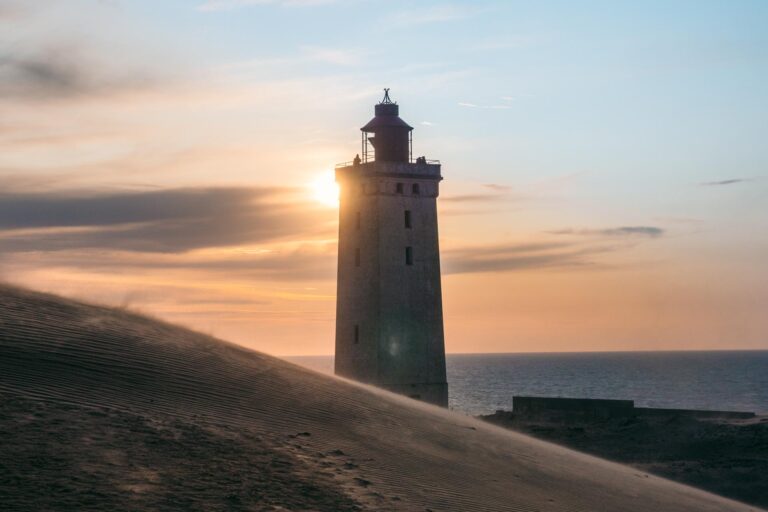
Everything you need to know about Rubjerg Knude Lighthouse, including where to stay, where to eat and our best tips
Parking
Parking at the Sand-Covered Church is free.
There is also a playground for the children, toilets, tables and benches.

Map of Skagen and the Sand-Covered Church
The Sand-Covered Church (Sankt Laurentii Church) is located in the northern part of Jutland in Denmark, close to the town of Skagen.
Driving from Skagen to the church only takes around 7 minutes.
The ~ 3-4 kilometres can also be walked in about 40 minutes from Skagen. Walk along the path named Gamle Kirkesti (meaning “the old church path”) west of town, and you will reach the Sand-Covered Church easily.
Where to stay near the Sand-Covered Church
There are several lovely places to stay near the Sand-Covered Church in Skagen.
As we were travelling with a caravan on our way back from Norway, we spent the night at a campsite at First Camp Grenen Strand.
If you don’t have a caravan, auto camper or tent, we would recommend that you find a hotel in the city of Skagen.
Search for the best hotels near the Sand-Covered Church in Skagen here (adlink).
Skagen Hotel
Skagen Hotel is right by Skagen Station and it’s perfect for exploring the city.
The hotel is clean and neat and the rooms are stylishly designed. And the yellow house is really pretty, too!
Check prices and availability at Skagen Hotel here (adlink).


Skagen Strand Holiday Center
Take a look at Skagen Strand Holiday Center if you would prefer to have your own holiday apartment with a kitchen in Skagen.
There is room for either 5 or 7 people, and there is a free water park and playgrounds for the children as well as a fitness centre, minigolf, tennis and badminton courts.
A great choice if you’re staying in Skagen for longer than a few days.
Check prices and availability at Skagen Strand Holiday Center here (adlink).

Hotel Marie
If you are looking for a budget stay in Skagen, Hotel Marie has the option of double rooms or rooms for three singles with shared bathrooms, which lowers the price.
There are also double rooms with private bathrooms, but they, of course, cost a little more.
The hotel is located right by the harbour in Skagen, so you will be close to the city’s restaurants and cultural offerings.
Check prices and availability at Hotel Marie here (adlink).


Everything you need to know about the migrating coastal dune of Råbjerg Mile in northern Jutland, including what to do, where to stay and our best tips
Where to eat near the Sand-Covered Church
Skagen City is, without a doubt, where you will find the best places to eat close to the Sand-Covered Church in Skagen.
Luckily, it only takes around 7 minutes to drive between Skagen and the church tower.
If you want to eat as environmentally and animal-friendly as possible, we recommend eating plant-based food.
There are no completely vegan restaurants in Skagen (yet), but there are a few restaurants that offer vegetarian and vegan dishes:
- Juicy & Pizza. Delicious juices, smoothies, salads, wraps and sandwiches, plus Neapolitan sourdough pizza from a wood-fired oven, with vegan options.
- Bodilles Kro. Danish cuisine with a few vegetarian and vegan options.
- Cafe Knuth’s. Limited vegan options, but there’s a vegan falafel salad and a vegetarian burger.
Check out HappyCow for an updated list of places serving vegetarian and vegan food in Skagen.

Our best tips for visiting the Sand-Covered Church
- If you are thinking of visiting the church tower during the high season in summer (July-August), it may be a good idea to plan your visit outside the hot and popular hours from lunchtime to the afternoon. That way, you minimise the risk of sunstroke, and there will be fewer people around.
- If you visit the Sand-Covered Church at sunset, we can imagine you will get the most amazing light.
- Do your research and don’t expect a big church buried in sand (like we naively did) – but we guess you got that point by now.

What to bring to the Sand-Covered Church
- Travel insurance (adlink). Never travel without it!
- A good camera – here’s a guide to the gear we use.
- Sunscreen (adlink) if you visit in the summer.
- Hiking shoes, sandals or shoes you can walk in the sand in.
- Sunglasses, a hat or a head cover/protection of some kind for sunny days or for the sand if it’s windy.
- Water and snacks if you plan to stay for long.
What camera, drone and accessories we use to capture life on the road
Read moreMinimise your impact
To travel as sustainably as possible, we recommend the following:
- Bring your own drinking water in a refillable bottle.
- Avoid disposable plastic.
- Sort your trash correctly and do not throw it on the ground.
- Take only photos and leave only footprints. Avoid taking things from nature with you.
- Respect the local wildlife.
- Use an environmentally friendly sunscreen. The sun can be reflected in the sand, so it is a good idea to protect your skin – especially from the dangerous rays in the middle of the day – even in Denmark.

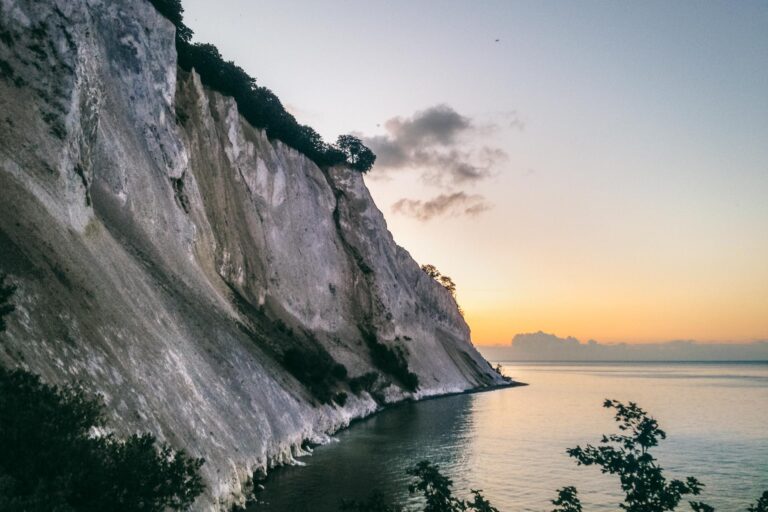
Everything you need to know about Møns Klint, what to do on Møn and where to stay
Read moreFAQ about the Sand-Covered Church in Skagen
Is the Sand-Covered Church actually buried in sand?
Not quite! Despite the name, the Sand-Covered Church is not a church buried under sand.
What remains today is just the church tower, standing among sand dunes.
The original nave was demolished after the church was abandoned in 1795, when sand from the surrounding dunes made it impossible to maintain.
Is it free to visit the Sand-Covered Church?
The area around the Sand-Covered Church is free to visit and open 24 hours a day, all year round. In summer, you can buy a ticket at the kiosk in the car park to go inside the church tower.
How do you get to the Sand-Covered Church from Skagen?
The Sand-Covered Church is around 3-4 kilometres from Skagen town centre, and it’s about a 7-minute drive.
You can also walk there in roughly 40 minutes along the scenic path called Gamle Kirkesti, which runs west of the town.
Is there parking at the Sand-Covered Church?
Yes, there is, and parking at the Sand-Covered Church is free. The car park also has toilets, a playground for children as well as picnic tables and benches.
How old is the Sand-Covered Church?
The original brick church dates back to the late 14th century, so it’s more than 600 years old.
The church tower, which is all that remains today, is believed to have been built around the year 1500.
What is the Sand-Covered Church called in Danish?
The Sand-Covered Church is known in Danish as Den Tilsandede Kirke or Sankt Laurentii Kirke.
It’s also sometimes referred to as the Sand-Buried Church, the Old Skagen Church or Sct. Laurentius Church.
How long does a visit to the Sand-Covered Church take?
A visit to the Sand-Covered Church (Den Tilsandede Kirke) typically takes 30-45 minutes, so it’s a relatively short visit.
There isn’t much to do, so it gives you enough time to walk from the car park, explore the remaining tower, read the information boards and take a few photos of the surrounding dune landscape.
If you want a slower visit or combine it with a walk in the nearby plantation, you might spend closer to an hour.
When is the best time to visit the Sand-Covered Church?
The Sand-Covered Church can be visited year-round.
In summer, aim for early morning or evening to avoid the crowds and midday heat. Visiting at sunset is particularly recommended for the light over the dunes and the sea.
Thanks for reading along
Thank you for reading our travel guide to the Sand-Covered Church in Skagen. We hope it has been helpful!
What do you think of the church tower?
If you’ve already been there, let us know your best tips and tricks.
If you haven’t been to the northern tip of Jutland yet, don’t hesitate to ask us anything in the comments. We are happy to help.


Our favourite travel resources:
- Booking.com for hotels and apartments.
- Momondo for the best flight deals.
- AirHelp for flight delay compensation.
- GetYourGuide for great tours everywhere.
- Airalo for reliable eSIM.
- Discover Cars for transparent car hire.
- SafetyWing for travel insurance. We also like True Traveller. Compared here.

Travel Guide to Skagen: 10 Best Things to Do & See at the Top of Denmark
Everything you need to know about Skagen in North Jutland, including why you should visit, what to do, where to stay and our best tips
-
Råbjerg Mile in Skagen: Travel Guide to the Largest Migrating Dune in Northern Europe
Everything you need to know about the migrating coastal dune of Råbjerg Mile in northern Jutland, including what to do, where to stay and our best tips
-
Travel Guide to Grenen in Skagen: The Best Things to Do at Denmark’s Northernmost Point
Everything you need to know about the long sandbar at Skagen Odde including what to do, where to stay and our best tips


