Slowly slowly
Although our speedboat from Koh Lanta reached Koh Jum after just 20 minutes, there’s nothing fast about this island.
At our hotel, it soon became clear that many of the other guests weren’t on holiday so much as living there. Koh Jum is an island which people seem to come to for weeks or months at a time.
It’s bigger than Koh Mook and even slower and less touristy, with three villages, a big hill in the north, quiet roads and several beaches down the west coast.
There are no chains, no parties to speak of and, as far as we could find, only one ATM. This is the old-fashioned Thai island experience.
We stayed four nights on Koh Jum in February 2026, two adults and two kids, plus Victoria’s mother.
In this guide, we cover what to do on Koh Jum, when to visit, how to get there and what to know before you go.
Where to stay on Koh Jum:
- Budget: Sunset Beach Bungalow Koh Pu – Rustic bungalows on Sunset Beach.
- Value for money: Andaman Beach Resort – Where we stayed. Simple bungalows with air conditioning on a long, quiet beach, and a very relaxed crowd.
- Luxury: Koh Jum Beach Villas – The island’s top resort. Large villas, some with private pools, in a garden by the beach that feels like a small botanical park.
Search for the best hotels on Koh Jum here.
Table of contents

Why visit Koh Jum
Koh Jum is best for doing very little and taking it slow.
Despite the relaxed atmosphere, it’s surprisingly easy to get to. Koh Lanta is a 20-minute speedboat ride away, and Krabi, Ao Nang and Railay are also close by in the other direction.
The island is mostly Muslim, with mosques in the villages, and it’s all very local and low-key.
Accommodation and food are cheap compared to the neighbouring islands, which are kinda pricey.
The main roads are good and barely used, so getting around by scooter is easy.
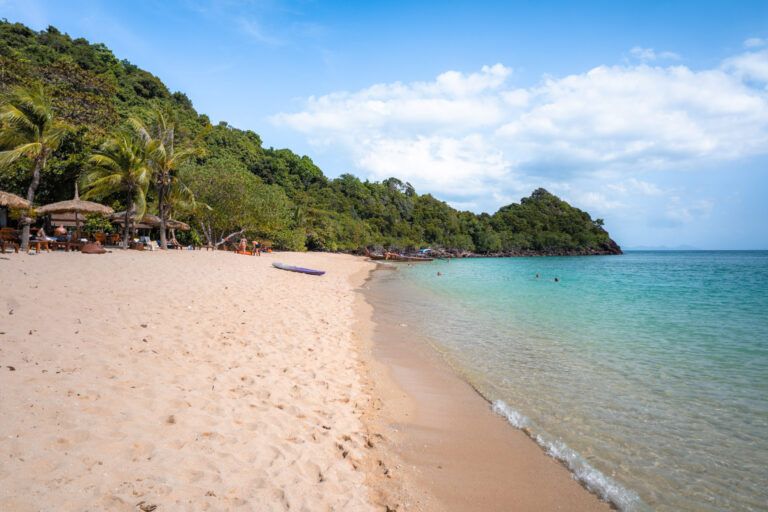
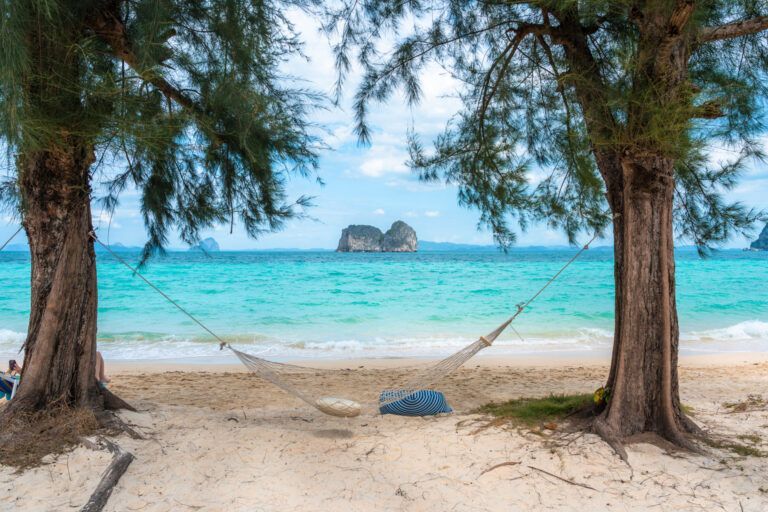
For some, the catch is that the beaches are fine but not truly amazing. The sand is firm rather than powdery, and the water doesn’t look as clear as on some of the other islands in the Andaman Sea.
Koh Jum’s beaches are still very pretty, though, and extremely calm even in high season.

Where is Koh Jum?
Koh Jum is in Krabi Province in southern Thailand, roughly 25 kilometres (~ 16 miles) south of Krabi town and just north of Koh Lanta.
The island has two names. Officially, it’s Ko Pu (also written Koh Pu or Koh Poo), and that’s what the locals call the northern, hillier half.
The southern half, where the main village and the speedboat pier are, goes by Koh Jum (also written Ko Jum), and that’s the name most visitors use for the whole island.
It really is just one island, which makes the two names a bit confusing. We’ll stick with Koh Jum.
There are three villages: Ban Ko Jum in the south, Ban Ting Rai in the middle and Ban Ko Pu in the northeast.
The forested hill in the north, Khao Ko Pu, rises to around 400 metres (~ 1,300 feet). You’ll see it from most of the west-coast beaches.
Nearly all the places to stay are located along the west coast, facing the sunset, with the villages and the piers on the east side.


How many days to spend on Koh Jum
We stayed four nights, and that was a good length for us.
It gave us slow beach days by the resort, and Alex had time for a scooter tour of the whole island.
Two nights works if Koh Jum is a stepping stone between Koh Lanta and Krabi. You’ll get a full beach day and two sunsets.
Our where-to-stay guide goes deeper into how long to stay on Koh Jum and what the days can look like at each length.


Best things to do on Koh Jum
Most of what there is to do on Koh Jum involves a beach.
Alex visited most of the island on a scooter in a single morning, so most of the beach descriptions below are his. Here’s our list:
- The long southern beach – Where we spent most of our time
- Rent a scooter and do the loop – The best way to see the island
- Coconut Beach – Palms all the way to the sand
- Sunset Beach – Rustic beach bars
- Magic Beach and the northwest track – For confident scooter riders
- Banyan Bay – A giant tree and a well in the sea
- To Pi Beach – The quiet beach just south of the village
- The villages – Ban Ko Jum and Ban Ko Pu
- Hike Khao Ko Pu – The island’s mountain, with a guide
- Take a boat trip – Mangroves, small islands and Phi Phi
1. The long southern beach – Where we spent most of our time
The main beach on Koh Jum stretches a long way down the southern half of the west coast, backed by casuarina trees and a handful of resorts.
Our hotel, Andaman Beach Resort, was right on it, and so is the island’s most luxurious resort, Koh Jum Beach Villas (adlinks).
The beach in front of our hotel was pretty good. The sand isn’t the softest, and at low tide the water pulls back to reveal a lot of rock, but right in front of the resort there was one spot where you could still swim.
What the beach does extra well, though, is having crabs. Lots and lots of tiny ones, plus a few hermit crabs.
Walk about a kilometre north, to the tall coconut palms just before La Isla Koh Jum Cafe & Restaurant, and the beach is even better.
There are rocks here that take the waves and leave small rock pools behind, and the water is crystal clear under the noon sun.


2. Rent a scooter and do the loop – The best way to see the island
Koh Jum is too big to walk, so a scooter is the best way to see it.
Alex rented one from our hotel for 150 baht* for 12 hours (~ 4 EUR / 4.5 USD) or 250 baht* for 24 hours (~ 7 EUR / 8 USD). In the village by the pier, it looked like you could rent your own tuk-tuk too.
The main roads are excellent, concrete and shaded, and we saw very little traffic.
The only tricky bit was the dirt track along the northwest coast, which we write more about under Magic Beach below.
Alex did the full loop in a morning, going up to Ban Ko Pu in the northeast, around the north end past Banyan Bay and Coconut Beach to Sunset Beach, down the rough track to Oonlee, and back through the main village to To Pi Beach.
*Prices are from 2026.


3. Coconut Beach – Palms all the way to the sand
Coconut Beach, on the northwest side of the island, was one of the nicest beaches Alex found on the loop.
It’s a small cove with a grove of tall coconut palms reaching right down to the sand.
The beach is nice even at low tide, and you can wade out and swim.
When Alex visited, there were very few people on the sand, with a few more at the restaurant of Mupa Resort (adlink), the small hotel by the beach.
Mupa has a rather stern sign at its entrance threatening a 500-baht fine (~ 14 EUR / 16 USD) for walking through the resort.
Luckily, you can walk or ride down beside it instead. The track is a little bumpy, but at a gentle pace it’s no problem on a scooter.


4. Sunset Beach – Rustic beach bars
A little further along the north coast, Sunset Beach is a curve of sand with shady trees and a rocky shoreline.
Like most of Koh Jum’s beaches, it’s very tidal. At low tide, there are rocks to cross to reach the water.
There are two or three small hotels along the beach, all in the rustic bungalow style, with driftwood-decorated beach bars under the trees.
Alex found a surprising number of people here when he came by.
As everywhere else on the island, you can book tours and massages from the bars. We also saw a banner for a live music night here, back by the road near our resort.


5. Magic Beach and the northwest track – For confident scooter riders
Between Sunset Beach and the resorts further south, the road along the northwest coast turns into a muddy, rocky dirt track with some steep, hilly stretches.
Alex’s scooter handled it fine, but you need to take it slowly and feel confident on two wheels.
It’s easy to imagine how slippery it would get after rain, especially on the steep bits, so skip it if it’s been raining.
Magic Beach, right by the Electric Bar, seemed to be the prettiest beach on this stretch.
It wasn’t obvious how to get down to it, but the sand looked lovely and there were people on it, so it can be done.
The track ends at Oonlee Bungalows (adlink), high above the water. There’s no real beach here, but there are rock pools you could probably swim in, and a sandier beach a little to the left with two more resorts on it.


6. Banyan Bay – A giant tree and a well in the sea
Banyan Bay, at the northern end of the island near Ban Ko Pu, is named after the very large banyan tree that’s behind the beach.
Its trunk is wrapped in coloured cloth with a spirit house at its foot.
Alex was here at low tide, and you can see it in the photos. The water was a long way out across the flats.
Even so, the beach itself looks good, with small cabanas and shady spots to lie down, a restaurant and the resort, Banyan Bay Villas (adlink), behind it.
The oddest sight is a freshwater well standing in what is, at high tide, the sea. There are steps down to it, and it seems to be fed by a spring. Kinda confusing how that works.


7. To Pi Beach – The quiet beach just south of the village
To Pi Beach is just south of Ban Ko Jum (the main village), down a short, slightly bumpy track. If you’re staying in or near the village, you can walk there.
When Alex got there, he shared the whole beach with just three other people.
The water looked fine. The sand isn’t the softest, but it’s not bad either. There’s a lot of shade under the trees, right where the track arrives.


8. The villages – Ban Ko Jum and Ban Ko Pu
Ban Ko Jum, the main village by the speedboat pier, is where most things happen on the island, at least for visitors.
There are plenty of small restaurants, minimarts, tour desks, scooter rentals and a shop or two selling sunscreen, snorkels and coconut oil.
It’s still a working village. Longtails lie in the mud at the old wooden pier, and a handwritten sign on a lamp post asks visitors to skip the bikini in the village.
Ban Ko Pu, in the northeast, is much more local. There’s a mosque, a school, a pier with a hand-painted timetable for the public boats to Laem Kruat on the mainland, and hardly a tourist in sight.
On the road to Ban Ko Pu, you’ll pass a Muay Thai school and two places advertising guided hikes up Khao Ko Pu (more on that next).


9. Hike Khao Ko Pu – The island’s mountain, with a guide
We unfortunately didn’t get to do this one, so here’s what we know from research and from the signs along the road.
Khao Ko Pu is the island’s forested peak, at around 400 metres.
A trail of roughly 3 kilometres (~ 2 miles) climbs from the Koh Pu side, starting in a rubber plantation, and most people reach the top in about an hour.
The path is steep in places, not marked and overgrown enough that going with a local guide is the standard advice.
Expect to pay around 1,000 baht (~ 25 EUR / 30 USD) per person.
Guides are advertised at the Koh Pu Center on the road to Ban Ko Pu, the same place as the Muay Thai school, and at tour desks in Ban Ko Jum.
From the top, you can see the Andaman Sea on all sides, with Phi Phi on the horizon.
Start early for the cooler air, bring water and good shoes, and expect mosquitoes on the way up. There are monkeys on the mountain too.


10. Take a boat trip – Mangroves, small islands and Phi Phi
We stuck to the island this time, but Koh Jum is a good base for private longtail trips, and every hotel and tour desk can arrange one.
The price list at our hotel gave an idea of what’s on offer.
A three-hour island tour to Coconut Bay, the small islands off the coast and the mangroves was 2,500 baht* (~ 70 EUR / 80 USD) for a private boat for up to four people.
A full day out to Phi Phi Ley, Phi Phi Don and Bamboo Island was 4,500 baht* (~ 120 EUR / 140 USD), and a sunrise mangrove trip from Mu Tu Pier was also on the list.
*Prices are from 2026.


Where to stay
Nearly all the accommodation on Koh Jum lines the west coast, and the choice is mostly about how far north you want to be.
The long beach in the south has the biggest cluster, including our hotel and the island’s luxury villas, with the main village a short tuk-tuk ride away.
At the northern end of the long beach, about a kilometre north of us, you get the nicest stretch of sand and a resort with a pool.
Beyond that, the northern beaches (Sunset Beach, Coconut Beach and Banyan Bay) are quieter and more rustic, and further from everything.
Compared to other islands in the Andaman Sea, hotels on Koh Jum are generally quite affordable.
- Budget: Sunset Beach Bungalow Koh Pu – Rustic bungalows right on Sunset Beach.
- Value for money: Andaman Beach Resort – Where we stayed. Simple bungalows with air conditioning on a long, quiet beach, and a very relaxed crowd.
- Value for money: Horizon Beach Resort – Beachfront family rooms and a pool at the northern end of the long beach.
- Value for money: Mupa Resort – The only hotel on Coconut Beach, a palm-lined cove you can swim from at low tide.
- Luxury: Banyan Bay Villas – A small pool resort on its own bay at the quiet northern end, by an enormous banyan tree.
- Luxury: Koh Jum Beach Villas – The island’s top resort. Large villas, some with private pools, in a garden by the beach that feels like a small botanical park.
Search for the best hotels on Koh Jum here (adlink).
Where we stayed: Andaman Beach Resort
We spent our four nights at Andaman Beach Resort (adlink), in a simple bungalow with air conditioning, a double bed, a single bed and, a rarity on Thai islands, a sofa.
The resort was super relaxed. Many of the guests were older, and a lot of them seemed to be staying for longer than the usual one to two weeks.
The beach in front is fine. It’s stony at low tide like much of Koh Jum, but with one spot where you can still swim.
From the pier, the hotel is about 8 minutes by tuk-tuk, and the island’s one ATM is close by.
Next door is the island’s luxury option, Koh Jum Beach Villas, where we ate and had drinks and ice cream.
Check prices and availability at Andaman Beach Resort here (adlink).


Where else should you stay on Koh Jum?
- Budget: Sunset Beach Bungalow Koh Pu – Rustic bungalows right on Sunset Beach.
- Value for money: Horizon Beach Resort – Beachfront family rooms and a pool at the northern end of the long beach.
- Luxury: Banyan Bay Villas – A small pool resort on its own bay at the quiet northern end, by an enormous banyan tree.
- Luxury: Koh Jum Beach Villas – The island’s top resort. Large villas, some with private pools, in a garden by the beach that feels like a small botanical park.
Search for the best hotels on Koh Jum here (adlink).
For the full run-through of each of these, a few more options and which part of the island suits you, head over to our where-to-stay guide to Koh Jum.
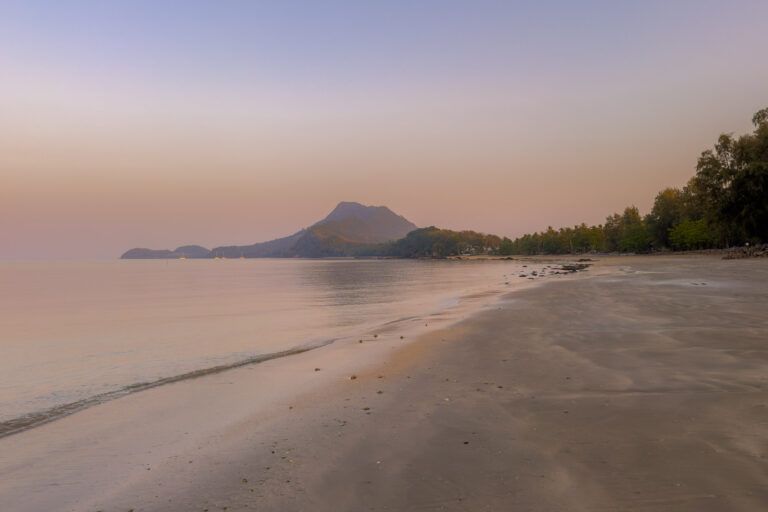
Our recommendations for the best places to stay on Koh Jum from budget to luxury
Read moreWhere to eat on Koh Jum
Eating on Koh Jum is cheap and unfussy. Most hotels have a restaurant, the main village has plenty of small places, and there are a few more along the road.
One place we can recommend is Mai’s Homestay, a mostly vegan spot on the main road with hand-painted signs out front and a warm welcome inside.
The food is homemade and tastes a little different from a typical Thai restaurant’s, with vegetables and ingredients you don’t usually get. It was one of the few places on the trip where we got brown lentils, in a slightly unorthodox khao soi.
La Isla Koh Jum Cafe & Restaurant is by the photogenic coconut palms, with a lovely view out over the water.
For something smarter, we ate and had drinks and ice cream at the beachfront restaurant at Koh Jum Beach Villas. It was pricier than our own resort, but still cheap by most Western standards.
Everywhere else, expect simple Thai food at low prices. There’s a small coffee shop with pastries by the pier, which is handy if you’re waiting for a boat.


Visiting Koh Jum with kids
We visited Koh Jum with a toddler and a baby (Adrian at 2.5 and Zoe at 6 months).
The island is calm, with little traffic and no crowds, which was delightful.
The beach in front of our resort had small crabs everywhere. At low tide, it turns into an enormous sand flat covered in crabs and their sand balls, with the occasional hermit crab. Adrian loved it, and still talks about those crabs months later.
There were rope swings under the big tree on the beach in front of the resort, and the garden paths at Koh Jum Beach Villas next door made for a nice walk.
There’s a medical clinic with an ambulance on the island, for a more peaceful mind. The mainland isn’t far either, though.
At low tide, swimming means a long walk out over rocks on most beaches, so it makes sense to save most of your beach time for high tide.
Or consider staying at Koh Jum Delight Beach (adlink), which has a kids’ section of the pool and family rooms.
The minimarts generally have a good selection, but we wouldn’t count on them for anything specialised. So if your child needs a particular formula, baby food or nappies, bring enough from home or from the mainland.


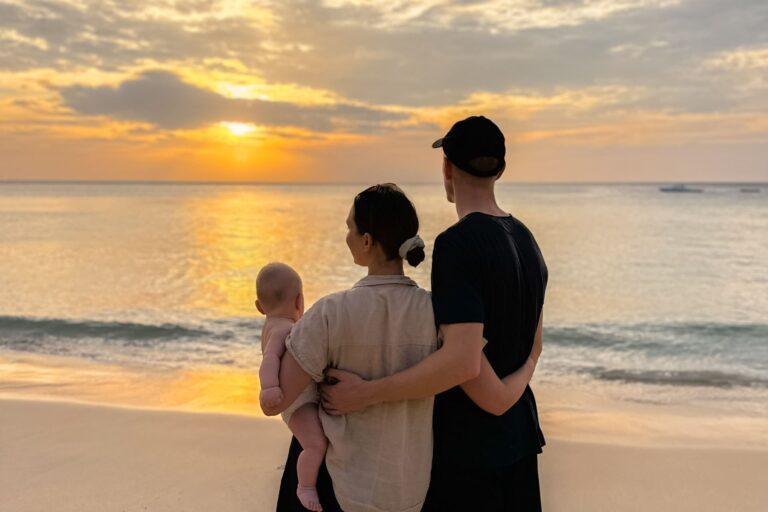
Everything we know about travelling in Thailand with a baby – including safety, packing, flights and where to stay
Read moreHow to get around Koh Jum
Tuk-tuk
Motorbike tuk-tuks with a covered sidecar meet the boats at the pier.
The ride to our hotel took about 8 minutes and cost 50 baht per person* (~ 1.5 EUR/USD), so 150 baht for our three adults.
Hotels and tour desks can call one for you, and in the village it looked like you could even rent your own.
Scooter
Renting a scooter is the best way to explore Koh Jum. The price was 150 baht* for 12 hours or 250 baht* for 24 hours from our hotel, and there are also plenty of rental places in the main village.
The main roads are good, quiet and often shaded. Only the dirt track along the northwest coast needs extra care.
*Prices are from 2026.
Walking
The beach in front of the southern resorts is long enough for a proper walk, and the village is walkable once you’re in it.
Between the beaches, the distances add up, so most people ride.


How to get to Koh Jum
Koh Jum is easy to reach in high season.
It’s right on the boat route between Koh Lanta and Krabi, and the mainland is a short longtail ride away.
From Koh Lanta
This is what we did. The Bundhaya speedboat from Saladan Pier on Koh Lanta took just 20 minutes (though it was announced as 30 minutes).
Boarding on Lanta meant a fairly steep ramp and a climb across another boat, but there were plenty of staff to help, and they took care of all our luggage.
The crossing itself was completely smooth.
On Koh Jum, we climbed a short ladder from the boat straight up into Koh Jum Seafood Restaurant by the pier in the main village. From there, tuk-tuks took us to our hotel.
Expect to pay around 800 baht per adult* (~ 20 EUR / 25 USD) and 650 baht per child* to go from Koh Lanta to Koh Jum, with a morning and an early afternoon departure in high season.
Search 12Go (adlink) for the current schedules.
*Prices are from 2026.
From Krabi, Ao Nang and Railay
We left Koh Jum this way, on the morning ferry to Ao Nang.
The Lanta Super Concord ferry left Koh Jum at 09:15 and reached Ao Nang at around 11:00, for 600 baht per adult* (~ 16 EUR / 19 USD) and 450 baht per child*.
It serves Klong Jilad Pier in Krabi town too (10:45, 550 baht*).
Speedboats also go to Ao Nang pier in the early afternoon for around 900 baht* (~ 25 EUR / 30 USD) including the ride to your hotel.
The same boats run in the opposite direction, so Koh Jum is an easy first island if you fly into Krabi Airport.
From Krabi Airport, it’s about 20-30 minutes by taxi or Grab to Krabi town for the ferry at Klong Jilad Pier.
To Laem Kruat, the mainland pier for the public longtail that sails all year, it’s about a 30-minute drive from the airport.
The longtail takes about 40 minutes to cross to Koh Jum.
In high season, the speedboats from Ao Nang leave from Nopparat Thara pier, one late in the morning and one in the early afternoon.
Combined tickets from the airport, with a van or private car and then the longtail, can be booked in advance on 12Go (adlink).
Some hotels arrange the airport transfer themselves, so ask yours.
*Prices are from 2026.
From Phi Phi, Phuket and the Trang islands
In high season, the speedboats that call at Koh Jum also connect it with Koh Phi Phi (around 800 baht), Phuket (around 1,750 baht) and, heading south, Koh Ngai, Koh Kradan, Koh Mook (around 1,500 baht) and all the way to Koh Lipe.
Prices are from the 2026 list at our hotel and include the tuk-tuk to the pier.
From the mainland by longtail
The public longtail boats between Mu Tu Pier on Koh Jum and Laem Kruat on the mainland run all year, several times a day.
The price is 140 baht* (~ 4 EUR / 4.5 USD) per adult and half that for children.
Laem Kruat is about 40 kilometres (~ 25 miles) south of Krabi town.
This is the local route, and as far as we know the only one that keeps running in the low season.
*Price is from 2026.
Which option should you choose?
Coming from Koh Lanta, take the speedboat.
From Krabi or Ao Nang, the morning ferry is a comfortable choice, and the speedboats are the quicker option.
Outside high season, or if you’re on a tight budget, use the local longtail from Laem Kruat.


When to visit Koh Jum
Seasons and weather
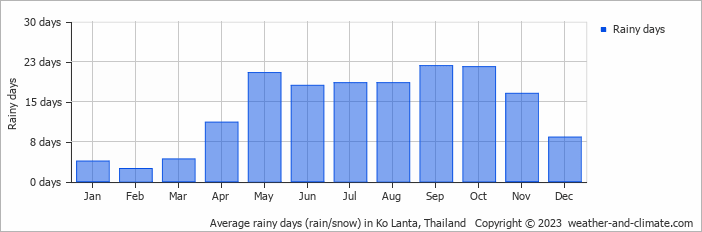
Koh Jum has a warm, tropical climate year-round, with temperatures usually somewhere between 24°C and 32°C (75-90°F).
Like the rest of the Andaman coast, the island has three main seasons. There’s the cool dry season (the high season), the hot season and the rainy season.
Many hotels and restaurants close for parts of the rainy season, so options can be limited from June to October.
That said, weather patterns can vary from year to year, so having a bit of flexibility is always good.

What is the best time of year to visit Koh Jum?
The best time to visit Koh Jum is generally from December to February, with cooler temperatures, plenty of sunshine and calm seas.
November and March are also good times to travel, with slightly lower prices than in the peak weeks.
November to February (Koh Jum’s high season):
We visited Koh Jum in February 2026, and we had sunshine every day.
This is Koh Jum’s high season, with the most visitors and the most stable sunny weather. Even then, the island never felt busy to us. Far from it.
Temperatures are slightly cooler, and hotel prices are higher, especially from around mid-December to mid-January.
If you’re planning to travel to Koh Jum over Christmas or New Year, we recommend booking accommodation well in advance.
March to May (the hottest months):
Koh Jum generally experiences the highest temperatures from March to May, with rainfall starting to pick up towards the end of this period.
The school year in Thailand ends around late February or early March, when many local families travel to escape the hottest months.
If you’re planning to visit in March, April or May, it might be worth paying extra for a room with air conditioning and access to a pool, which only a handful of places on Koh Jum have.
June to August (the start of the rainy season):
From June (or sometimes as early as May), the heat begins to subside as the southwest monsoon brings heavier rainfall to the Andaman coast.
The rain usually falls in intense showers and rarely lasts all day, so there are still plenty of sunny hours.
In July and August, Koh Jum is at its greenest, and accommodation prices drop significantly.
In these months, the water becomes less clear, and the calm conditions of high season give way to bigger swells on some days. The west-coast beaches face straight into the monsoon.
September and October (the wettest months):
September and October are the wettest months on Koh Jum, with frequent heavy rain.
The sea can be noticeably rougher and murkier, and boat trips and swimming in the sea aren’t always possible during this time.
The rainfall can be intense, so it’s wise to be prepared with an umbrella and a good book if you find yourself needing to stay sheltered for a while.
Many of the smaller bungalow places on Koh Jum close from around June to October.
Only a handful of places stay open year-round, so check with your hotel before booking boats or flights.
Koh Jum stays reachable year-round thanks to the public longtail from Laem Kruat on the mainland, but the speedboats from Koh Lanta and Krabi mostly stop outside high season, and crossings can be cancelled on the roughest days.

The best times to visit Thailand and what to expect – from the tropical islands to the northern hills
Read moreTips for visiting Koh Jum
- Bring cash. We found only one ATM on the island, near the middle of the west coast, and most places are cash only.
- Dress modestly in the villages. Koh Jum is mostly Muslim, and a sign in Ban Ko Jum politely asks visitors to leave the bikini on the beach.
- Check the tides. Most beaches lose a lot of water at low tide, so plan swims around high tide. We often use Tideking for this.
- Take the northwest track slowly on a scooter, and skip it altogether after rain.
- Keep your hands free when boarding boats. Between ramps, ladders and climbing across other boats, a backpack is easier than a suitcase here.
- Keep an eye out for monkeys. We only saw them sneaking about in the forest, but they’re around, especially up towards the mountain.
- Koh Jum is a beautiful island. Make sure to bring a good camera! Here’s our guide to lightweight photography gear for high-quality travel content.
- Bring your own water bottle and refill at your hotel instead of buying plastic bottles.
- The sun is strong. Remember reef-safe sunscreen and seek out the shade in the middle of the day.
- Remember travel insurance before you go. There’s a clinic with an ambulance on the island, but the nearest hospital is off the island. We compare the best travel insurance for digital nomads and long-term travellers here.
- Pick up an eSIM. Mobile data is your safety net on a small island. We’ve previously used Airalo (adlink) with great success.
- Travelling with little ones? Have a look at our guide to visiting Thailand with a baby for what worked (and didn’t) for us.


Essential Thailand travel tips covering costs, local customs, transport, safety and more.
Read moreSustainable travel tips
Koh Jum is a working island with rubber plantations, fishing villages and a forested mountain. A few easy ways to keep it that way:
- Bring a refillable water bottle and refill it at your hotel.
- Avoid single-use plastics where you can. Everything brought to the island has to leave it, too.
- Use reef-safe sunscreen, especially if you snorkel.
- Respect the wildlife, from the crabs on the beach to the monkeys in the forest. Don’t feed anything.
- Respect local customs. Cover up away from the beach and keep the noise down in the villages.
- Take only photos and leave only footprints.
Planning a trip to Thailand? Don’t miss our guide with tips for visiting Thailand, packed with must-know travel advice, local customs and important things to avoid for a lovely holiday and a respectful visit.

How to behave ethically as a tourist in the country of smiles
Read moreFAQ about Koh Jum
Is Koh Jum worth visiting?
Yes, if a quiet, low-priced island with decent (mostly not spectacular) beaches sounds like your kind of place.
If you’re after the clearest water in the Andaman, the Trang islands further south do that better.
Koh Jum or Koh Lanta?
They’re only 20 minutes apart and quite different.
Koh Lanta has more beaches, restaurants, hotels and traffic. Koh Jum is smaller, quieter and cheaper, with a stronger village feel.
With the boat ride this short, doing a few nights on each is easy.
Koh Jum or Koh Mook?
Both are low-key islands with real villages. Koh Mook is smaller and walkable, and has the Emerald Cave and the famous sand spit.
Koh Jum is bigger and is even less visited. For Thailand first-timers, Koh Mook might feel easier, but both islands are great for newcomers and old-timers alike.
Is there an ATM on Koh Jum?
We found one, near the middle of the west coast, close to the health clinic.
Bring enough cash anyway, as most places don’t take cards.
How do you get from Koh Lanta to Koh Jum?
By speedboat from Saladan Pier in about 20 minutes, with a couple of departures a day in high season. See the “How to get to Koh Jum” section above for prices.
Can you visit Koh Jum on a day trip from Koh Lanta?
Yes, in high season, with the scheduled boats.
The morning Bundhaya speedboat from Saladan Pier and the early-afternoon one back give you about four and a half hours on the island.
The boats arrive on the east side, and the beaches are on the west, so part of that time goes on the tuk-tuk ride.
We’d stay at least a night, though. Koh Jum doesn’t have sights to tick off, and its point is the slow days and evenings.
What is the best beach on Koh Jum?
Coconut Beach in the northwest is high on Alex’s list.
It’s a small cove with tall coconut palms right down to the sand and hardly anyone there, and you can wade out for a swim even when the tide is out.
Magic Beach on the northwest track looked like the prettiest on that stretch, but it’s not obvious how you get down to it.
On the long beach where we stayed, the nicer part is about a kilometre to the north, by the tall palms just south of La Isla Koh Jum Cafe & Restaurant, where the rocks leave small rock pools and the water is clear.
Can you swim at low tide on Koh Jum?
On most beaches it isn’t easy. The sea goes a long way out and leaves rocks or flats that you have to cross first.
We plan our swims around high tide and check the tide timings.
The two exceptions we found were Coconut Beach and one spot just in front of Andaman Beach Resort (adlink).
A resort with a pool is the other more obvious way to get a swim at any hour.
Thanks for reading our Koh Jum guide
Thanks for reading our travel guide to Koh Jum. We hope it has been useful!
Have you been to Koh Jum, or are you weighing it against Koh Lanta or the Trang islands for your trip? Drop us a note in the comments. We love hearing from fellow travellers.

Our favourite travel resources:
- Booking.com for hotels and apartments.
- Momondo for the best flight deals.
- AirHelp for flight delay compensation.
- GetYourGuide for great tours everywhere.
- Airalo for reliable eSIM.
- Discover Cars for transparent car hire.
- SafetyWing for travel insurance. We also like True Traveller. Compared here.

Where to Stay on Koh Jum: The Best Hotels in All Price Ranges
Our recommendations for the best places to stay on Koh Jum from budget to luxury
-
Koh Ngai Nature Trail: Hiking Guide to Paradise Beach and the Viewpoints
All you need to know about the jungle hike on Koh Ngai, including the route, how hard it is and what to bring
-
Where to Stay on Koh Ngai: The Best Hotels in All Price Ranges
Our recommendations for the best places to stay from budget to luxury