
The magical contrasts of the Harz Mountains
Step into the captivating Harz Mountains, a world where nature’s artistry takes centre stage along with time-honoured culture.
We’ve had the privilege of exploring this alluring region in Northern Germany not once, but twice, first in November 2021 and then again in June 2023.
Seasons in the Harz
Much of the beauty of the Harz Mountains lies in its ability to transform with the seasons, offering a captivating display of contrasts.
We were awestruck by the kaleidoscope of colours during autumn, as the landscape blazed with fiery reds, burnt oranges and brilliant yellows. And when we returned in June, everything had transformed into a lush green paradise.
In this photo guide, we’re thrilled to share the best picture spots the Harz Mountains have to offer.
While the appearance of these locations may vary depending on the season (oh, how magical it must be to visit at the height of snowy winter!), they will always provide a stunning backdrop for your Instagram feed.
So, grab your camera, pack your sense of wonder and get ready to immerse yourself in the Harz Mountains’ photo-worthy splendours!
All you need to know before visiting
For everything you need to know about visiting the Harz Mountains, including the best things to do, best places to stay, where to eat, when to visit and much more, check out our complete travel guide to the Harz Mountains here.
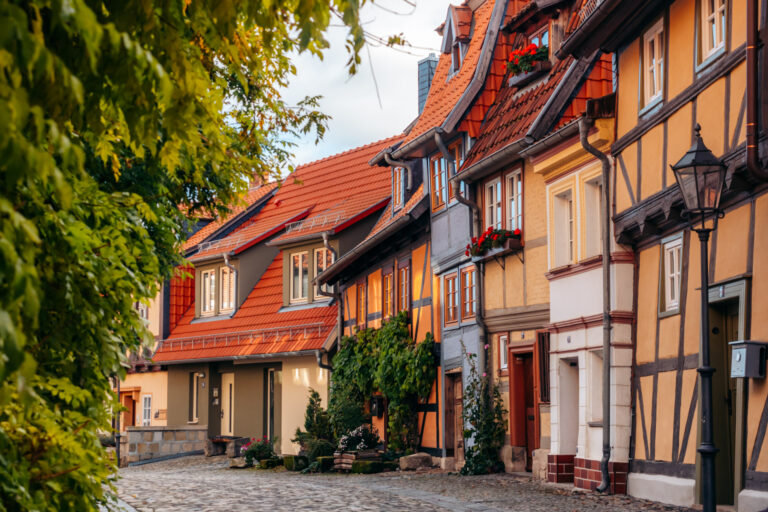
Everything you need to know including the best attractions, when to visit, where to stay and how to get around
Table of contents


Map and geography
Right in the heart of Germany, the Harz Mountains are easy to reach from major cities via well-connected autobahns.
Yet, they’re just far enough to whisk you away from the chaos of urban life.
In technical terms, the Harz Mountains span across three German states: Lower Saxony, Saxony-Anhalt and Thuringia.
Stretching for approximately 100 kilometres from west to east and 32 kilometres from north to south, this region is a gem waiting to be explored.

The 21 best photo spots and viewpoints in the Harz Mountains
Views of charming towns with old churches and towers as well as expansive nature vistas are everywhere in the Harz Mountains.
We truly hope you’ll have an amazing time exploring the region!
Here are the 21 best photo spots and viewpoints in the Harz Mountains:
- Mittelsteine and Königstein – Teufelsmauer
- Hamburger Wappen – Teufelsmauer
- Burg Lauenburg ruins – Old linden tree
- The streets of Quedlinburg – One of Germany’s most romantic towns
- Münzenberg – Quedlinburg Schlossberg views
- Lindenbeinscher Turm – Views over Quedlinburg
- Torfhausmoor – Circular hike in the national park
- Agnesberg – Wernigerode Castle viewpoint
- The streets of Wernigerode – Half-timbered houses everywhere
- Titan-RT Suspension Bridge – Vertigo views
- Oderteich Lake – Instagrammable lakeside spots
- Brocken – Northern Germany’s highest mountain
- Herzberger Teich – Lake next to the Rammelsberg Mine
- The streets of Goslar – Charming alleys and big churches
- Liebesbank trail – Forests, vistas and ponds
- Water reservoirs – The Upper Harz Water Management System
- Aussichtsturm Kuckholzklippe – Lookout tower
- Innerstetalsperre – Nice lake at sunset
- Walkenried Monastery – Go back in time
- Magdeburger Hütte – Mountain layers to the horizon
- Okerstausee views – From Schulenberg
Teufelsmauer (Devil’s Wall)
Get ready to encounter the Teufelsmauer, also known as the Devil’s Wall, a series of fantastic rock formations spanning approximately 20 kilometres between Blankenburg and Ballenstedt in the eastern part of the Harz region.
Though located near towns and amidst agricultural fields, it’s a great place to feel transported further away from civilisation and deeper into nature.
The Teufelsmauer is surely one of the best photo spots in the Harz Mountains.
In our opinion, the most interesting stone formations are the “Großvater”, “Hamburger Wappen”, “Papensteine”, “Königstein”, “Mittelsteine”, “Dicker Stein” and “Gegensteine”.
1. Mittelsteine and Königstein
On our first visit to the Harz, we walked to the Mittelsteine and Königstein from Thale. We parked here.
The hike is not that long, but the views are incredible!


2. Hamburger Wappen
On our second visit, we went to Hamburger Wappen from Timmenrode. We parked here.
Alex ascended the huge boulder on some “stairs” cut into it. Be careful if you do the same, especially if it’s windy.
There’s also a small and easily accessible cave next to Hamburger Wappen, and it’s ideal for your Instagrammable photos, too.


3. Burg Lauenburg ruins – Old linden tree
High above the small village of Stecklenberg, you’ll find the ruins of Lauenburg Castle.
The tower at Kleine Lauenburg (Small Lauenburg) offers great vistas of the landscapes below.
But the real star of the show is Große Lauenburg (Big Lauenburg) with its unique old linden tree that has taken root above the castle walls, perfectly exemplifying how nature will always find its way.
We parked by the “Naturfreundehaus Schullandheim Stecklenberg” and hiked the roughly 1.6-kilometre forest path to Große Lauenburg, with about 160 metres of ascent.


4. The streets of Quedlinburg – One of Germany’s most romantic towns
Renowned as one of Germany’s most picturesque towns, Quedlinburg is a fairytale countryside destination that promises to transport you to another era.
With more than 2,000 timber-framed houses, some standing for centuries, there’s an almost endless array of cute, atmospheric cobblestone streets here, perfect for photo walks.
On both of our visits to Quedlinburg, the Schlossberg (Castle Hill) was partly hidden by scaffolding. The renovation has since finished, so you should get a clearer shot than we did.


Advertisement
Everything you need to know about Dresden in Germany, including what to do, where to stay and our best tips
5. Münzenberg – Quedlinburg Schlossberg views
Some of the best views in Quedlinburg can be seen from Münzenberg, looking straight towards the famed Schlossberg.
While up here, we also recommend walking the cute backstreets and discovering the Münzenbergmuseum.


6. Lindenbeinscher Turm – Views over Quedlinburg
The Lindenbeinscher Turm (Lindenbein Tower) is a part of the stunning hotel Schlosshotel Zum Markgrafen (adlink).
For a 1-euro coin per person, it’s possible to walk up the stairs of the tower and get great 360-degree views of Quedlinburg, including the Schlossberg and the Altstadt (old town).


7. Torfhausmoor – Circular hike in the national park
There is an incredible number of lovely hikes in the Harz National Park. One of the better ones is the hike around Torfhausmoor.
Panoramic vistas abound. And we really loved the pretty boardwalk near the beginning of the hike!
The full hike is around 4.5 kilometres long and will take about 1.5 hours to complete (without photo stops!).


All you need to know about Düben Heath Nature Park and the area in Saxony-Anhalt in Germany including what to do, where to stay and our best travel tips
8. Agnesberg – Wernigerode Castle viewpoint
The viewpoint of Agnesberg in Wernigerode is a hidden gem for photographers, offering breathtaking views of the fairytale-like Schloss Wernigerode (Wernigerode Castle).
Hiking up here isn’t difficult, but it does involve a climb of around 100 metres on forest paths.
We parked (for free) at “Parkplatz Am Lustgarten“. The viewpoint is right by “Stempelstelle HWN 31” (a Harzer Wandernadel stamping point).


9. The streets of Wernigerode – Half-timbered houses everywhere
Nestled in between Goslar and Quedlinburg, the old town of Wernigerode (Wernigerode Altstadt) is at least as stunning as its two charming counterparts.
Although the main street exudes a touristy vibe (still with many beautiful houses!), a short stroll away will lead you to secluded cobblestone pathways adorned with romantic half-timbered houses, providing a serene and intimate setting for unique photo opportunities.


Advertisement
10. Titan-RT Suspension Bridge – Vertigo views
Don’t miss the incredible photo opportunity at the Titan-RT Suspension Bridge, which runs parallel to the Rappbode Dam, the largest dam in the Harz region and the highest dam in Germany.
Spanning 458 metres, this suspension bridge offers breathtaking views as you walk 100 metres above the water below.
It’s not for the faint-hearted, but the vistas are absolutely worth it!


11. Oderteich Lake – Instagrammable lakeside spots
Discover the Oderteich, once the largest dam in Germany and now part of a UNESCO World Heritage Site within the Harz National Park.
Here, the former spruce forest has been left to nature’s whims, allowing wild vegetation to flourish and biodiversity to thrive.
For those seeking a leisurely yet rewarding hike with fantastic photo opportunities, the Oderteich is the perfect choice.
The circular route around the lake spans approximately 4.5 kilometres, a pleasant walk of about 1.5 hours.
In our opinion, the best photo opportunities at Oderteich Lake are to be found around the lake’s southwestern banks (near the parking lot) and the lovely boardwalks found to the northeast.


Everything you need to know including the best experiences, when to visit, where to eat and where to stay
12. Brocken – Northern Germany’s highest mountain
Brocken is a true Harz icon as Northern Germany’s highest mountain.
It’s a popular subject from afar, and the views from the top are naturally amazing in all directions. Sunrise or sunset should (of course) be particularly beautiful as you can see basically all of the sky.
There’s a circular path around the summit, which is great for a shorter visit. If you have more time, you can explore the many hikes.
Also, don’t forget to try and catch a photo of the famed steam train going up or down the mountain.


Advertisement
13. Herzberger Teich – Lake next to the Rammelsberg Mine
While there are certainly many interesting photo spots at the Rammelsberg Mine (near Goslar), we also loved the small lake nearby called Herzberger Teich where you can go out onto a small platform to admire the views.
Note: Drone flying is restricted in many parts of Germany, including national parks, nature reserves and residential areas, so check the zones on the official dipul map and get permission where you need it (preferably well in advance).


14. The streets of Goslar – Charming alleys and big churches
Goslar is the biggest town and unofficial capital of the Harz region.
With over 1,500 timber-framed houses lining the old cobblestoned pathways, each exuding unique charm, you’ll feel like you’ve stepped into a storybook.
Get your Instagram-worthy photos here!
The town’s collection of stunning churches adds grandeur to the picturesque streets.
Tip: Goslar offers more than just scenic photo opportunities that perfectly encapsulate the spirit of the Harz Mountains. The town is also an ideal base for your adventures in the region.
During our visits to Goslar, we’ve stayed at Hotel Alte Münze, Hotel Der Achtermann and AKZENT Hotel Villa Saxer (adlinks).
You can also search for the best value accommodation in the Harz here (adlink).


Advertisement
15. Liebesbank trail – Forests, vistas and ponds
For a relatively easy hiking trail with lots of diverse photo spots, we think you should consider walking the Liebesbank trail (Liebesbankweg) in Hahnenklee.
Liebesbank means “love bench” and refers to the fact that there are lots of specially designed benches placed along the trail where you can rest your legs.
The circular trail is about 7 kilometres long.


16. Water reservoirs – The Upper Harz Water Management System
The Upper Harz Water Management System (Oberharzer Wasserwirtschaft) includes more than 100 water reservoirs around the Harz Mountains.
Many of them are popular swimming holes in summer (and great photo spots in all seasons!).
While some of the water reservoirs are hidden a bit off the beaten track, others are really easy to reach with just short hikes from parking lots.


Everything you need to know about Sylt including what to do, where to stay on the island and our best travel tips
17. Aussichtsturm Kuckholzklippe – Lookout tower
The Aussichtsturm Kuckholzklippe (Kuckholzklippe lookout tower) in the Harz Mountains has panoramic views over the surrounding landscape.
We parked at “Parkplatz Untere Innerste” and hiked for about a kilometre each way to reach the lookout tower.


18. Innerstetalsperre – Nice lake at sunset
Near Goslar, the Innerstetalsperre (Innerste Dam) is a great place to catch the reflections of the sky in the (usually) still water.
It’s a popular place to visit around sunset, but there should still be plenty of free parking along the road.


All you need to know about Saale-Unstrut and the wine region in the southern part of Saxony-Anhalt in Germany including what to do, where to stay and our best travel tips
19. Walkenried Monastery – Go back in time
The Walkenried Monastery (Kloster Walkenried in German) is a photographer’s delight with its well-preserved ruins, Gothic arches and atmospheric cloister offering plenty of opportunities to capture the historical charm and architectural beauty of the former Cistercian monastery.
The interplay of light and shadow adds a touch of drama, making it a perfect spot for striking photographs of this remarkable abbey, part of a UNESCO World Heritage Site.
Remember to see both the inside of the monastery, with its gorgeous halls, and the huge church ruins outside on the grounds.
Walking around the cute town of Walkenried is also easy to recommend.


20. Magdeburger Hütte – Mountain layers to the horizon
This is one of the easiest photogenic vistas to reach in the Harz Mountains.
You can park right next to the Magdeburger Hütte and be immediately greeted with expansive views of the national park.
The spot around the hut isn’t particularly big, but there is (naturally) a wide array of hikes to go on in the immediate area.


21. Okerstausee views – From Schulenberg
It’s always great to get a bird’s-eye perspective on naturally beautiful places, and that’s exactly what you’ll get from the hills of Schulenberg over the Okerstausee.
One of the best places is the “Wohnmobilstellplatz Schulenberg im Oberharz” (a motorhome site), but the whole area is full of great photo opportunities, including the nearby Romkerhaller Wasserfall.


Advertisement
What to expect from visiting gorgeous Eibsee in the Bavarian Alps
Read moreWhere to stay in the Harz Mountains
When deciding where to stay in the Harz Mountains, you’ll find that the region is compact enough to explore easily from anywhere.
Whether you prefer the serene atmosphere of the mountains for hiking or the convenience of a historic centre with a wider choice of restaurants, there is an ideal place for every traveller.
For those seeking a balance between natural beauty and urban amenities, a central location in the Harz Mountains would be the perfect fit. In towns like Goslar, Quedlinburg and Wernigerode, you can relish the best of both worlds.
We will give you some recommendations on the best hotels and apartments in the Harz Mountains down below.
Search for the best value accommodation in the Harz Mountains here (adlink).
Pssst… You can also check out our full guide on where to stay in the Harz Mountains to learn more about the best towns to base yourself in and see more pictures of the hotels.
Advertisement

The best places to stay in Goslar:
- Haus Mittenmank am Marktplatz (5*) – Luxurious apartments right in the heart of town.
- Romantik Hotel Alte Münze (4*) – Perfect location with a historic feel.
- AKZENT Hotel Villa Saxer (4*) – Very modern with amazing views over Goslar.
- Hotel Der Achtermann (4*) – Goslar’s biggest hotel with a huge spa area and swimming pool.
- Hotel Harzlodge (2*) – A cheaper alternative located just outside the city walls.
Search for the best value accommodation in Goslar here (adlink).


The best places to stay in Quedlinburg:
- Romantik Hotel am Brühl (4*) – A beautiful, romantic hotel where we stayed during our first visit to Quedlinburg.
- Schlosshotel Zum Markgrafen (4*) – Decadent living in a castle with great attention to detail.
- Bellevue Ferienwohnungen (4*) – On our second visit to Quedlinburg, we stayed in this apartment and loved it!
Search for the best value accommodation in Quedlinburg here (adlink).


The best places to stay outside of Goslar and Quedlinburg in the Harz Mountains:
- Wernigerode: Boutique-Hotel Anno 1910 – Stylish hotel in the heart of the old town.
- Ilsenburg: Landhaus Zu den Rothen Forellen (5*) – True spa luxury at the foot of Brocken.
Search for the best value accommodation in the Harz Mountains here (adlink).


Our personal recommendations for the best places to sleep in the Harz
Read moreHow to get around the Harz Mountains
By car
The road network in the Harz Mountains is well developed, and it’s quick to get pretty much anywhere in the region.
You’d be hard-pressed to find trips inside the Harz Mountains that take much more than an hour’s drive, which means you’ll have more time to create stunning photographs!
Parking is generally free in most places. In the towns and near attractions, you may have to pay a small fee if you park centrally. Remember to bring euro coins for parking.
By public transport
We haven’t used any public transport in the Harz Mountains ourselves (except for the steam train to Brocken), but it should definitely be possible to go almost wherever you like with a combination of local trains and buses.
Many trains and buses have timetables and routes that are specifically designed for hikers.

How to get to the Harz Mountains
By land
The Harz Mountains are connected to the German autobahn, meaning you can get here by car from all over Europe in a whizz.
Be aware that people drive very fast on the sections of the autobahn that don’t have speed limits. Overtake with caution.
By train
It’s possible to travel by train from all over Europe to the Harz Mountains.
Goslar is the main hub, but you can also go to Wernigerode and Quedlinburg, for example.
By air
Fly into Berlin, Hamburg, Hannover, Leipzig or Frankfurt and catch a local train or hire a car to get to the Harz Mountains.

All you need to know about visiting Zugspitze from Garmisch-Partenkirchen
Read moreWhen to visit the Harz Mountains
There’s no bad time to visit the Harz Mountains, but as with most other holiday destinations, steering clear of the main holiday seasons is a good idea if you want to avoid crowds and enjoy cheaper accommodation.
Spring is a beautiful time to visit with warming weather, rushing water and blooming flowers.
Summer is naturally the warmest season. The summer holidays in Germany are spread out between the middle of June and the middle of September. When we visited in June, we had incredible, warm and sunny days.
Autumn is a wonderful time. When we visited the Harz Mountains in the middle of November we were lucky to still see some colourful leaves on the trees. For the best autumn foliage, it might make sense to visit a little bit earlier.
Winter is a popular time to visit for winter sports. Especially so during Christmas and New Year. During heavy snowfall, the Harz Mountains turn into the most perfect fairytale winter landscape.


What to expect from visiting the stunning Partnach Gorge in Garmisch-Partenkirchen, Bavaria
What to bring to the Harz Mountains
- Travel insurance (adlink). Never travel without it.
- A good camera (of course!) – here’s a guide to the gear we use.
- Sunscreen (adlink). The sun can be strong even in winter.
- Hiking shoes, sneakers or other comfortable shoes you can walk in.
- Swimwear and a towel if you plan to swim or stay at a hotel with a spa.
- Water and snacks.
What camera, drone and accessories we use to capture life on the road
Read moreMinimise your impact
To minimise your impact during your visit to the Harz Mountains, follow these guidelines:
- Bring your own drinking water in a refillable bottle.
- Avoid single-use plastics, including straws.
- Dispose of waste properly.
- Check your sunscreen if you intend to swim. Many brands contain oxybenzone and other chemicals that are harmful.
- Take only photos, leave only footprints. Let everything stay in its natural place.
- Be considerate of other visitors.
- Respect wildlife.
FAQ about visiting the Harz Mountains
What are the best viewpoints in the Harz Mountains?
Brocken is Northern Germany’s highest mountain, and from the top you can see in every direction. There’s a circular path around the summit, and at sunrise or sunset you get nearly the whole sky.
The Titan-RT Suspension Bridge is 458 metres long and takes you 100 metres above the water next to the Rappbode Dam, Germany’s highest. In the towns, the Lindenbeinscher Turm in Quedlinburg shows you the Schlossberg and the old town all the way round for a 1-euro coin per person, the Münzenberg terrace looks across to the Schlossberg too and Agnesberg in Wernigerode looks down on Schloss Wernigerode.
We’d also add the Magdeburger Hütte, where you park beside the hut and get ridge after ridge out to the horizon. The Kuckholzklippe lookout tower, the tower at Kleine Lauenburg and the hills of Schulenberg above the Okerstausee are on our list as well.
Which Harz photo spots can you reach without a long hike?
The Magdeburger Hütte is the easy one. You park next to the hut and the view over the national park is right there.
The Innerstetalsperre near Goslar works well at sunset, and there should be free parking along the road. Some of the Upper Harz reservoirs are only a short walk from a parking lot, the small cave next to the Hamburger Wappen at the Teufelsmauer is quick to get to and the old towns of Quedlinburg, Wernigerode and Goslar are good for a photo walk.
For the Brocken you can let the steam train do the climbing. The Kuckholzklippe lookout tower is about a kilometre each way from the Parkplatz Untere Innerste, and Agnesberg means around 100 metres of climbing on forest paths that get steep in places.
When is the best time to photograph the Harz Mountains?
We’ve been in mid-November and in June. In autumn it’s reds, oranges and yellows, and there was still some colour on the trees in mid-November, but for the best foliage go a bit earlier.
The thick autumn fog gave the reservoirs a mysterious feel, which we liked. June was lush and green with warm, sunny days, spring brings rushing water and flowers, and in winter heavy snow turns the region into a proper winter landscape.
Time of day matters as much as the season. The Brocken at sunrise or sunset gives you nearly the whole sky, the Innerstetalsperre at sunset reflects it in water that’s usually still, and keeping clear of the main holiday seasons means fewer people in the frame.
Can you fly a drone in the Harz Mountains?
You can, but not everywhere. Federal rules restrict drone flying in national parks, nature reserves and residential areas, and the official zone map is dipul (dipul.de).
That matters here because the Harz National Park covers Torfhausmoor, the Oderteich and the Brocken. Look at the map before you take off and ask for permission where it’s required, ideally well ahead of time.
We had permission for our aerial photo of the Herzberger Teich near Goslar. The lake is a good subject from the ground as well, with a small platform at the water’s edge.
Thanks for reading
Thanks for getting all the way to the end! We hope this photo guide to the best spots for photographers in the Harz Mountains has been useful.
Remember to check out our complete travel guide to the Harz Mountains with the best things to do here for even more tips for visiting the region.
What do you think about the northernmost mountains in Germany and all of the lovely historic towns?
If you’ve been to the Harz, it would be awesome to hear about your experience. Do you have any favourite locations for photos we missed?
If you haven’t visited yet, please don’t hesitate to ask us anything. We’re more than happy to help.


Our favourite travel resources:
- Booking.com for hotels and apartments.
- Momondo for the best flight deals.
- AirHelp for flight delay compensation.
- GetYourGuide for great tours everywhere.
- Airalo for reliable eSIM.
- Discover Cars for transparent car hire.
- SafetyWing for travel insurance. We also like True Traveller. Compared here.

Where to Stay in the Harz Mountains? The Best Towns & Hotels in Germany’s Northern Fairyland
Our personal recommendations for the best places to sleep in the Harz
-
A Complete Travel Guide to the Harz Mountains: 16 Best Things to Do in Germany’s Secret Adventure Wonderland
Everything you need to know including the best attractions, when to visit, where to stay and how to get around
-
Review of Leiners Boutiquehotel für Familien: A Family Hotel in Garmisch-Partenkirchen
We review our stay at Leiners Boutiquehotel für Familien in Garmisch-Partenkirchen


Thank you for making this article very useful and keep up the good work