Colourful Copenhagen
So, you’ve spotted pictures of colourful houses in Copenhagen, and you’re wondering where to find them yourself?
Whether you’re searching for the best streets in Copenhagen for a photo walk or simply want to explore the prettiest streets Copenhagen has to offer, you’re in the right place.
Because we get you!
Even though we have been roaming these streets for most of our lives, we still enjoy dropping by to catch yet another colourful photo.
The old streets are so unique and charming.
But where are the colourful houses in Copenhagen? Well, it’s not only one place!
There are actually many colourful streets dotted all across the city, and here are our favourite 12 picturesque areas and streets with brightly painted buildings in Copenhagen.
Table of contents
Nyhavn
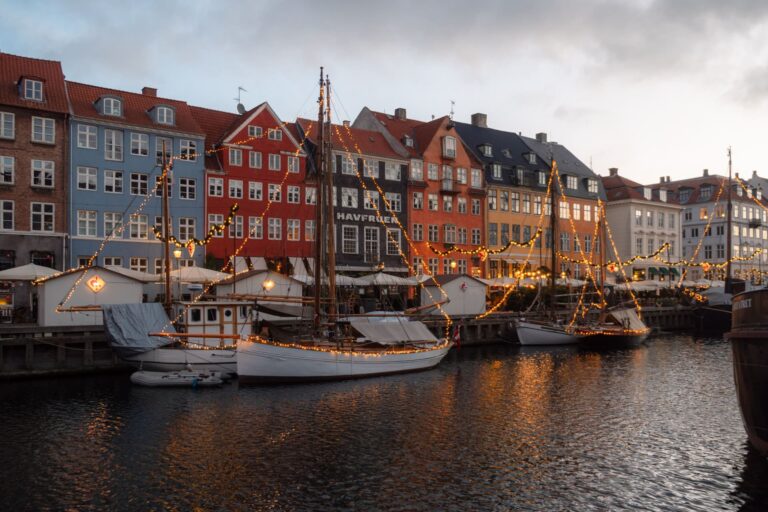
You have probably already heard about Nyhavn, but we simply had to include one of the most iconic views from Copenhagen!
Nyhavn is arguably the most famous street in Copenhagen, or… Canal-side street, to be precise.
The row of colourful townhouses reflected in the water is one of the most photographed scenes in all of Scandinavia.
Nyhavn, which means the new harbour, used to be known for sailors, brothels and shady bars.
While there are still a few places you can get an (overpriced) beer, the waterfront is now a popular spot to hang out and enjoy the atmosphere for tourists and locals alike.
Some of the coloured houses in Nyhavn are more than 300 years old and they are not to be missed on a trip to Copenhagen.
Local tip: In Nyhavn, you’ll find plenty of restaurants, cafés, bars and ice cream shops, but honestly, this is not where you find the best quality food, and you can expect it to be a bit pricey (like in all touristy places). For a cup of coffee or a beer in the sunset, it’s great though. Check out the nearby Broens Gadekøkken for awesome street food.


The Frederiksholm Canal Area
Looking for truly old and cute houses?
You’ll find many in the streets near the beautiful Frederiksholm Canal, which encircles the islet of Slotsholmen and Christiansborg Palace (where the Danish Parliament is located).
Magstræde is oh so charming, and it’s one of the prettiest streets in Copenhagen.
You can’t help but fall in love with this little old colourful street!
Along with the neighbouring street Snaregade, it’s in fact one of the oldest streets in Copenhagen, and if you stroll down the cobblestoned streets in this area, you’ll see many quirky and unique houses in different colours.
Make sure to also swing by Nybrogade, Knabrostræde and Gammel Strand for more adorable houses.
If you are looking for a great walking street with lots of cafés and small shops, check out Kompagnistræde.


The Old Inner City (The Latin Quarter)
In the city centre, you’ll find plenty of soft-hued houses side by side on the streets of Sankt Peders Stræde, Larsbjørnsstræde, Teglgårdstræde and Larslejsstræde.
This area is also known as The Latin Quarter.
It’s full of coffee shops, bars, restaurants, bicycle shops, as well as vintage and second-hand shops, making it perfect for a leisurely stroll.
We love the atmosphere here.


Landemærket
The colourful houses on the street of Landemærket are some of Copenhagen’s prettiest.
While it may be tricky to capture them without cars in the frame, they’re still some of our favourites.
For a unique view, head up to Filmtaget (“the film roof”) – Cinemateket’s free rooftop viewing platform.


Gråbrødretorv
Though it’s smack-middle in Copenhagen’s most touristy area, the square of Gråbrødretorv feels like a safe space where you can recharge your energy.
The huge tree is the obvious star of the show, but the colourful houses all around it also play a pivotal role in making the square so cosy.
You’ll also find beautifully coloured houses on Niels Hemmingsens Gade, which borders Gråbrødretorv.


Christianshavn
Christianshavn actually consists of several small islands between Zealand and Amager.
The neighbourhood really has its own charm with lots of canals and, luckily for this guide, a colourful palette of houses.
Make sure to check out Amagergade, Overgaden Oven Vandet and Sofiegade to see some of the prettiest ones.
If you are in Copenhagen on a sunny day, you should definitely go for a walk in Christianshavn.
The Freetown Christiania is located in Christianshavn too, and here you’ll see plenty of cool graffiti walls.


Nyboder
The houses at Nyboder are all yellow, and it’s a very unique area in the central part of Copenhagen.
The historical houses are former Naval barracks built by Christian IV for the personnel of the Royal Danish Navy.
It’s close to the longest street in central Copenhagen, Store Kongensgade (The Great King’s Street), where lots of restaurants and speciality shops are located.
Compared to Store Kongensgade, Nyboder is a quiet area, and it’s mostly residential. Please be respectful if you want to take pictures of the locals and their property.
You’ll want to check out Suensonsgade, Olfert Fischers Gade and Sankt Pauls Gade.
These are some of the coolest Copenhagen streets you’ll visit if you like a mix of history and cute, colourful houses.
Make sure to head for Sankt Pauls Gade if you want to see St. Paul’s Church, an old Lutheran church.
Oh, and it might be fun to know that some of the streets are named after animals, like Delfingade (Dolphin Street), Tigergade (Tiger Street), Haregade (Hare Street) and Krokodillegade (Crocodile Street).


Palads Cinema
This iconic, ugly-but-charming cinema offers the widest selection of films in Denmark, and the place brings back so many childhood memories of Disney movies and popcorn.
Palads (which means Palace) is on this list because of its controversial exterior design.
The cinema was painted in multiple pastel colours in 1989, and while opinions on its look are divided, it has somehow become a beloved city landmark.
There’s been an ongoing debate about the future of Palads Cinema, and plans have involved rebuilding much of the structure and modernising the cinema.
However, thousands of residents have opposed the redevelopment, arguing that Palads represents a unique, playful side of Copenhagen that shouldn’t be replaced by something more generic.
Politicians have agreed to preserve the building’s renowned colourful facade, and we think you should go see it for yourself.
It’s located right next to the train station Vesterport and not far away from the Central Station.


Sankt Hans Gade
There aren’t a lot of brightly coloured houses in the Nørrebro neighbourhood, but Sankt Hans Gade has some that might do for your colour hunt.
It’s close to the Copenhagen Lakes (more specifically Sortedams Sø) and the lively square of Sankt Hans Torv.
The nearby streets of Ravnsborggade and Ryesgade are super charming, too.


Olufsvej
Olufsvej is just one single street, but if you don’t have a lot of time in the city, this is the best street in Copenhagen to visit for a truly local feel.
Side by side, you’ll find the most delightful, coloured houses.
Not two of them are alike and if you come by in the summer, many of them are decorated with gorgeous flowers.
And while you’re here, do yourself a favour and swing by Olufs ice cream shop to treat yourself to an Italian-style ice lolly (including a few vegan ones).


Kartoffelrækkerne
These houses were built on land previously used for growing potatoes, and the name, Kartoffelrækkerne, actually means rows of potatoes.
It’s a residential area in Østerbro consisting of around 480 houses, and a few of our friends actually grew up in beautiful houses on these quiet streets.
The original facades were yellow with red stripes. Today, most of them are painted in neutral or pastel colours.
The streets might not be as colourful as some of the earlier mentioned, but it’s a very nice area and like on Olufsvej, you won’t see two identical houses.
You’ll find a few coloured ones in Webersgade, J. A. Schwartz Gade and Voldmestergade.
Once again, please be respectful towards the residents.


Dragør
Technically, Dragør is not a part of Copenhagen as it’s a town on the island of Amager (just 15 minutes drive from the airport).
For most visitors, it’s close enough to the city that the distinction barely matters.
We included Dragør on this list because of the old part of the town.
It’s one of the best preserved cities in Denmark, and the cobbled streets with narrow houses from the 1700s and 1800s are simply too lovely to be missed.


Map of the colourful houses in Copenhagen
Though it’s by no means comprehensive, here’s a map of the streets with colourful houses in Copenhagen mentioned in this guide.
Want to visit Copenhagen?
Hopefully, this guide to our lovely hometown has inspired you to explore some of the prettiest streets in Copenhagen and track down those iconic colourful houses for yourself.
Whether you’re a first-time visitor or a returning traveller, Copenhagen’s colourful streets never get old.
If you want to read more about our capital, check out our guides to Copenhagen – including why you should visit, where to stay, how to find cheap flight tickets and more.
Travel on a budget by knowing which hubs connect cheaply to Copenhagen
Read moreThanks for reading our guide to colourful houses in Copenhagen
We truly appreciate you taking the time to read our guide to the most beautiful coloured houses in Copenhagen.
We hope you found our tips useful!
Which Copenhagen streets are you most excited to visit?
Feel free to drop a comment and let us know what you think.
Our favourite travel resources:
- Booking.com for hotels and apartments.
- Momondo for the best flight deals.
- AirHelp for flight delay compensation.
- GetYourGuide for great tours everywhere.
- Airalo for reliable eSIM.
- Discover Cars for transparent car hire.
- SafetyWing for travel insurance. We also like True Traveller. Compared here.

Where to Stay in Østerbro & Nordhavn, Copenhagen: The 10 Best Hotels & Apartments
Our recommendations for the best places to stay in the family-friendly neighbourhood
-
Christmas in Copenhagen: 18 Best Christmas Markets in 2026
Everything you need to know about the best Christmas markets in Copenhagen, including where to find them and when they are open
-
How to Travel Sustainably in Copenhagen: 14 Tips for an Eco-friendly Visit
Be a responsible traveller when visiting Denmark’s green capital